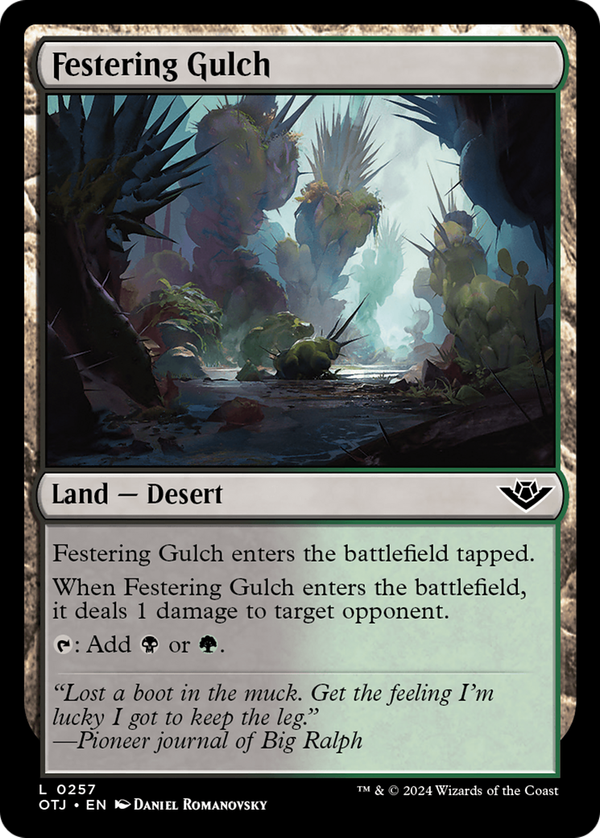
Festering Gulch
A dual land that comes in tapped is old news; a dual land that pings the opponent on the way in is a small piece of design opportunism. The 1 damage will never win a game on its own, but it is not free-floating, either: it stacks a clock that a black-green attrition deck is already trying to build, and it turns every land drop into a shockingly small point of reach. That matters most against decks racing to a life-total threshold or against control mirrors decided by a single burn spell. The trade is the usual tapland tax: a turn of tempo surrendered for fixing plus a scrap of inevitability. What makes it more than a taxed dual is that the trigger cares about the opponent's life total rather than your board, so it does damage even when you are behind, even when you have no creatures, even when the rest of your hand is dead. It is a mana source that keeps chipping when nothing else is happening, and that quiet persistence is the entire pitch. Black-green rarely wants for a haymaker; what it wants is the incremental edge that closes a game two turns early, and a land that does a point of that work by existing is a cheaper way to buy it than any spell.
Rules text
 : Add
: Add  or
or  .
.