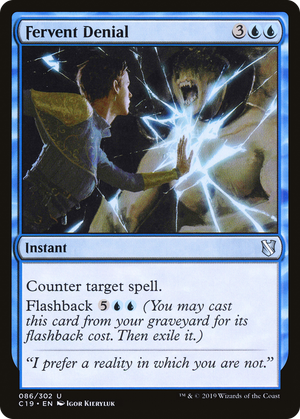
Fervent Denial


Counterspell's pitch was always speed and finality: two mana, gone forever. This rewrites both halves of that bargain. The up-front cost balloons to , well above the rate a hard counter wants to pay, but the card does not vanish when it leaves the stack. It falls into the graveyard, and flashback lets you cast it a second time for a heavier  , after which it finally exiles. That structure changes how the card lives in a deck. It is not a tempo answer you hold open early; it is an attrition piece, a way for a control deck to grind out the long game by answering two threats with one card slot. The graveyard becomes a second hand, and flashback turns interaction into a recurring resource you spend, recover, and spend again. The price is paid twice precisely because the value is. This kind of design belongs to an era that mined the graveyard for renewed value rather than letting it sit as a dead pile, and a counter that buries itself and then claws back out applies that thesis to the one effect that normally cares least about permanence: an answer with a second life built in.
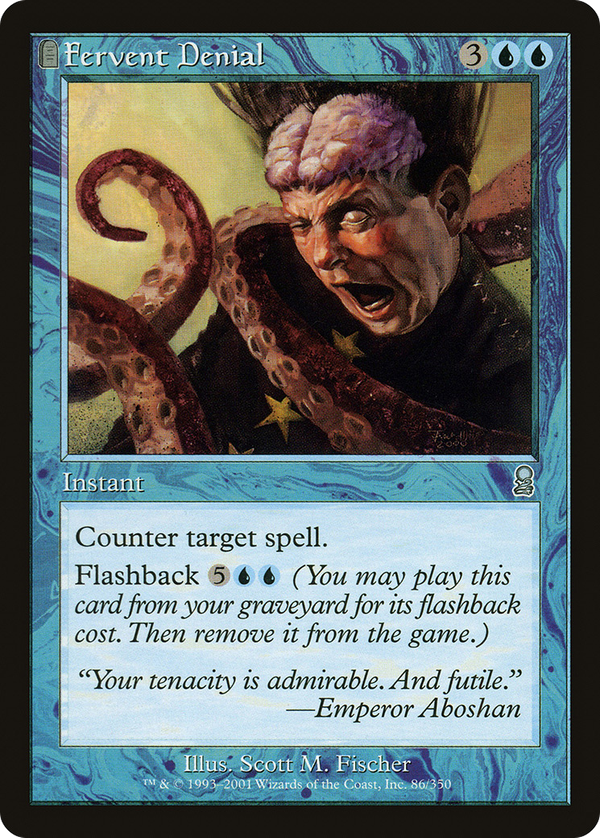
Rules text
(You may cast this card from your graveyard for its flashback cost. Then exile it.)