Fend Off


A standard Fog stops everyone for a turn but pays full freight to do it: when a single trampler, lifelinker, or evasive racer is the only attacker that matters, blanking the whole team is overkill, and on a quiet board it does nothing useful at all. Narrowing the prevention to one target is the design's answer to that mismatch. Aim it at the creature actually threatening to end the game and you neutralize the dangerous swing precisely, without committing a turn-long stall to a board you were never afraid of. The wording stays strictly inside combat, so it has no answer to burn, activated abilities, or anything dealt outside the attack step, and it delays rather than kills: the targeted creature is unharmed and swings again next turn. Cycling is what keeps this kind of situational prevention from rotting in hand. The cycling cost and the casting cost share a mana value, so in games where no single attacker scares you, the card converts from a dead effect into a fresh draw for roughly the same investment you would have spent casting it. It rewards reading the board correctly: aim it when one creature is the problem, cycle it when none is, accept that even at its best it buys time rather than solving anything. It belongs to an early-era family of one-shot prevention effects built to stay relevant even when their primary mode is dead, with cycling shouldering the flexibility that later removal would eventually fold straight into its rate.
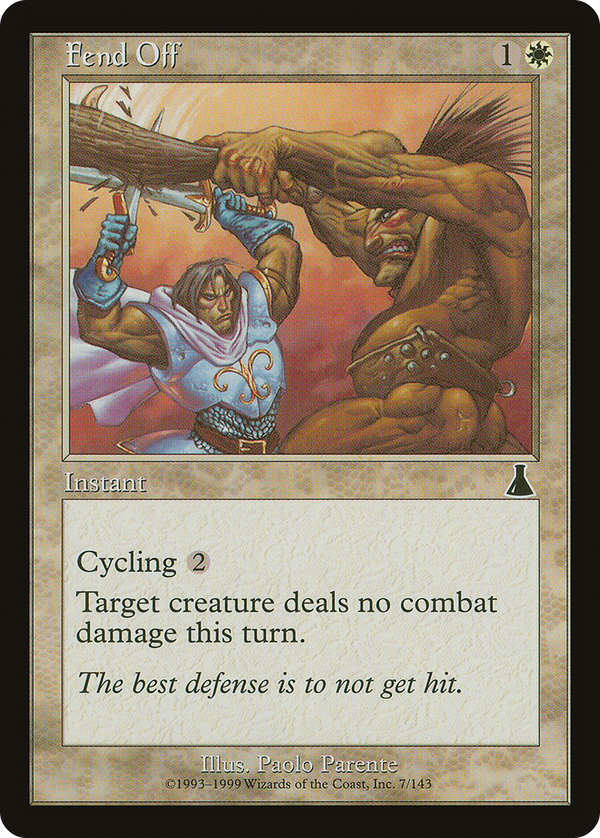
Rules text
 (, Discard this card: Draw a card.)