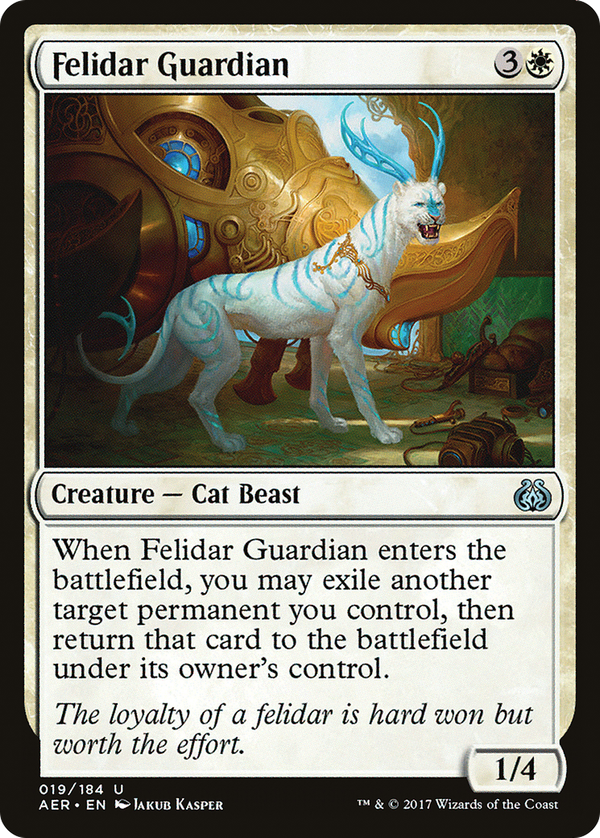
Felidar Guardian


The 1/4 body is a decoy; the engine is the target clause. "Another target permanent you control" sets no restriction on what gets flickered, which means the card is only ever as strong as the best enters trigger available to it. As a sorcery-speed effect on a creature without flash, it cannot react to anything: this is a proactive value tool, not a protective one. You blink to re-trigger an enters ability, untap a land, reset a planeswalker's loyalty, or repeatedly fire whatever the table's nastiest permanent does on arrival. The danger lives in scale. Pair it with an effect that can put another copy of the Guardian onto the battlefield, and each new copy blinks the engine that made it, recurring the loop until you decide to stop. Felidar Guardian on its own does almost nothing; with the right second card it generates an arbitrarily large number of enters triggers, and the partner does not have to ask for much. That is what made it a banlist conversation early in its life: a deterministic two-card kill that slotted neatly into a deck capable of also just playing fair creatures and attacking. It stands as the standing argument for why "you may blink a permanent" is never as innocent as the rate suggests; the constraint a designer leaves off the target clause is the constraint someone else will find a way to exploit.