Feaster of Fools


The interesting design question is why two mechanics that both eat creatures live on the same card without stepping on each other. Convoke and Devour both ask you to tap or sacrifice your board, but they pull in opposite directions: convoke wants those creatures alive at cast so they can pay for the spell, while devour wants them dead as it enters so it can feed on the corpses. The card exploits the gap between those two moments. Tap a creature to help pay the cost, resolve the spell, then sacrifice that same creature to devour as the demon enters, converting one body into both a discount and a pair of counters. A token-heavy board that would otherwise sit idle becomes a two-stage conversion engine: cheaper cast, bigger flyer. That double-dip is the whole reason the mechanics coexist here rather than feeling redundant. The 3/3 base body is deliberately unimpressive because the card was never meant to arrive at its printed size; it is a chassis that scales with how much of a go-wide board you are willing to liquidate. On an empty battlefield it is a six-mana 3/3 flyer, which is the price you pay for a payoff that only looks good when the rest of your deck is doing its job first. That dependence on a populated board is the balancing weight: no swarm, no discount, no counters, just a small demon.
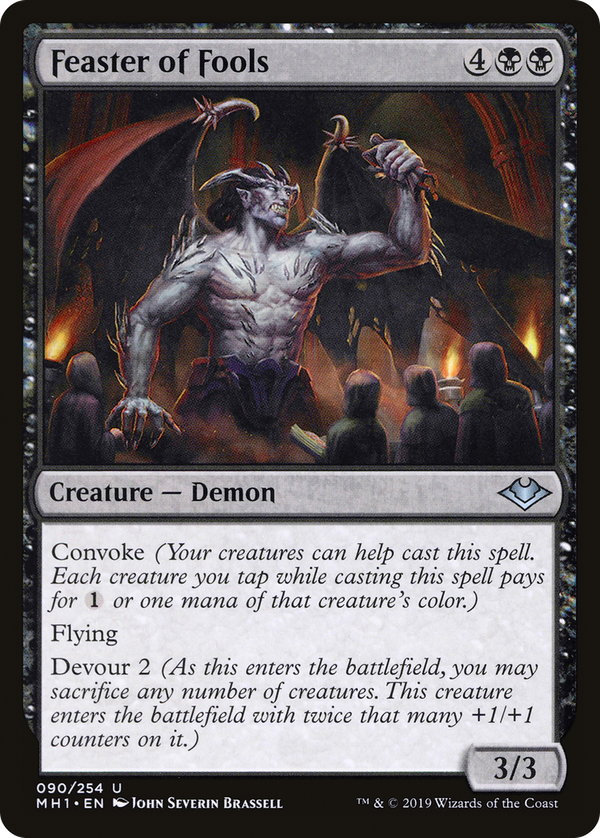
Rules text
 or one mana of that creature's color.)
Flying
Devour 2 (As this creature enters, you may sacrifice any number of creatures. It enters with twice that many +1/+1 counters on it.)
or one mana of that creature's color.)
Flying
Devour 2 (As this creature enters, you may sacrifice any number of creatures. It enters with twice that many +1/+1 counters on it.)