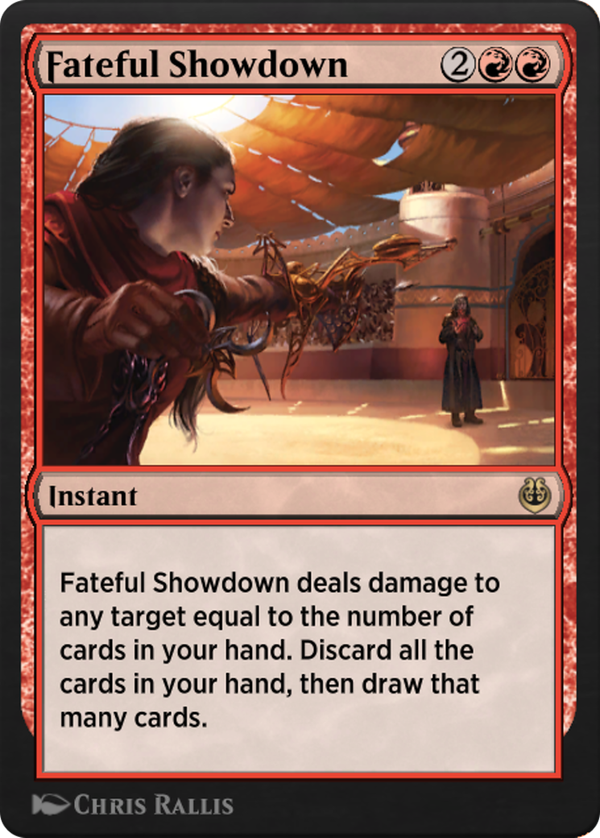
Fateful Showdown


The sequencing is the whole trick, and it runs cleaner than it first reads: the spell counts your hand for damage, then discards and draws that many. Because casting the spell puts it onto the stack, the card leaves your hand before the count happens, so a seven-card grip becomes six when it resolves: six damage to the face, six fresh cards drawn. That turns a flooded late-game hand from a liability into ammunition, because the cards you were about to dump are the same cards paying for the burn. It resolves the spellslinger's classic problem: a clogged grip you cannot deploy becomes a face-pointed chunk and a clean reload in one breath. Instant speed gives it teeth, letting you fire it when an opponent taps out or when a wrath would otherwise strand your hand anyway. The cost is that it scales with you, not against you: against an empty hand it deals zero and draws zero, a total blank, so it punishes the very player who most needs a reset. That self-referential build (your hand is simultaneously the fuel, the payload, and the reward) is what separates it from a straight burn-plus-cantrip split. You cannot buy the damage without committing to the reload, and you cannot reload without first paying out everything you were holding.