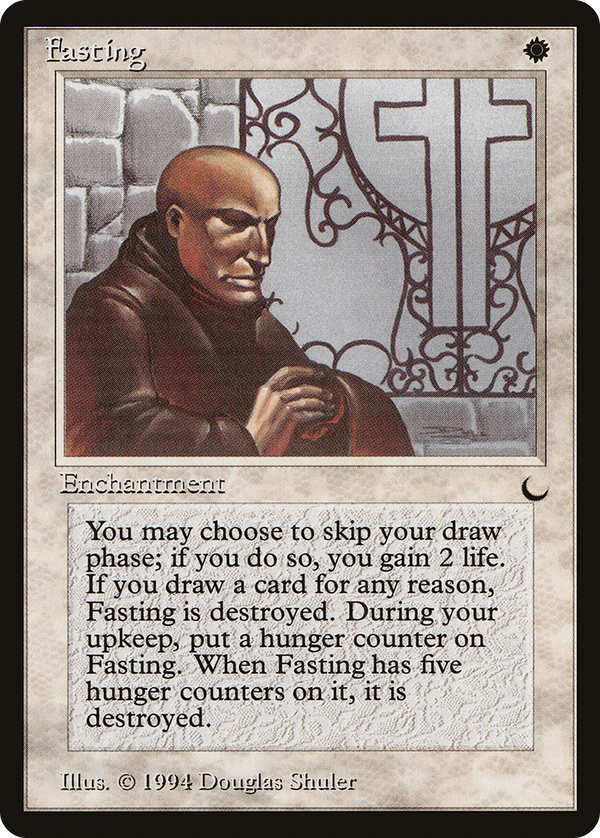
Fasting

A self-imposed clock that rewards you for not drawing. The premise is pure early-design austerity: you trade your draw step for two life, and the enchantment ticks up a hunger counter every one of your upkeeps until it either destroys itself at five counters or you finally relent and draw a card, which also destroys it. The math is the whole pitch. Cast at sorcery speed, the enchantment gets a counter on your next upkeep and is gone the upkeep it reaches five, which leaves exactly four draw steps to skip: bank eight life across its lifespan, then lose nothing but the card advantage you chose to forgo. The friction is that the counters are a leash, not a fuel gauge: there is no payoff for hitting five, only the eventual destruction, so the value lives entirely in how many life-gaining skipped draws your game plan can survive without fresh cards. That is a strange proposition in any era, and it reads as an artifact of a period when Wizards was still testing whether skipping a fundamental turn action could be a resource you spent voluntarily. The trade is symmetrical only with yourself: you are both the cost and the beneficiary, and the design never resolves who it is for. A relic of when the draw step was treated as something you could mortgage, printed before the game settled on card advantage as the axis nearly everything would eventually be measured against.