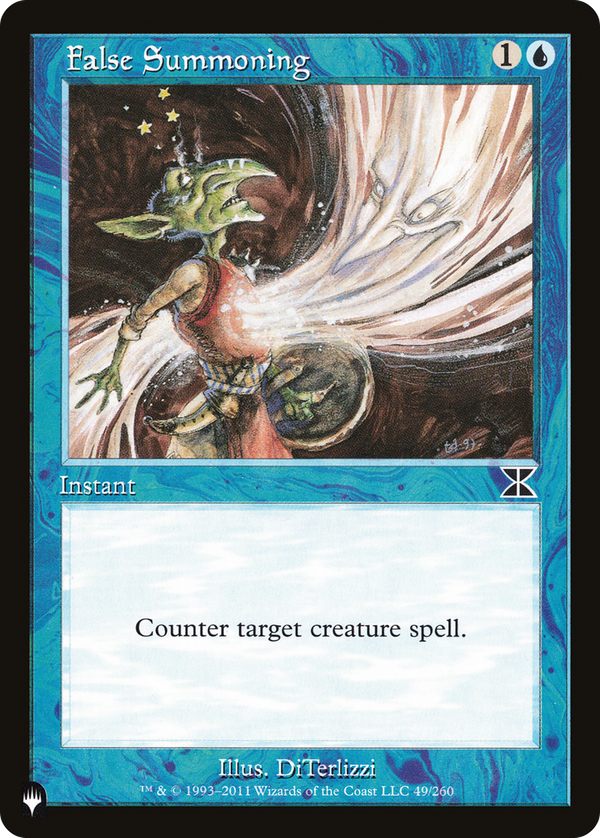
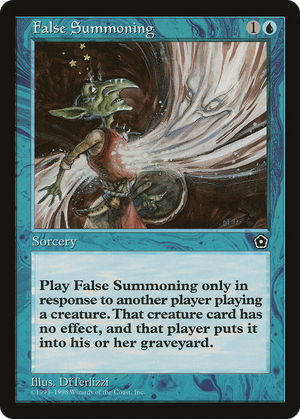
False Summoning


Counterspells in the Portal sets were a teaching tool, narrowed to the cleanest possible version of what the mechanic does. Where Counterspell stops anything, this stops exactly one category: creature spells, nothing else. That restriction was deliberate. Portal's design brief was to introduce new players to Magic without the full rules complexity, and "counter the monster before it lands" is the most intuitive frame for what a counterspell is. You see the creature on the stack, you stop it from arriving. No noncreature edge cases, no modal branches, no instant-versus-sorcery puzzles to untangle: the stack made legible for a first-time player. The trade-off is the obvious one: against a deck running few or no creatures, the card is a dead draw, which is why narrow counters like this have always been judged by how reliably their one target shows up. The design lesson sits in the mana line. The broader Counterspell asks for , two specific blue pips that lock you into a heavy blue commitment; this asks , a generic and a blue, easier to cast off a splashed mana base. So the narrowing buys something back: trade away the breadth of what you can hit, and the cost loosens to compensate. The skeleton of a counterspell is cheap, almost all of its power lives in the breadth of what it can name, and Portal priced that breadth honestly by handing it back in exchange for an easier color requirement.