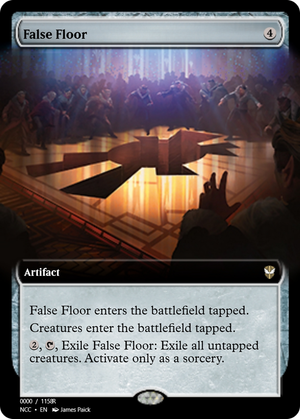
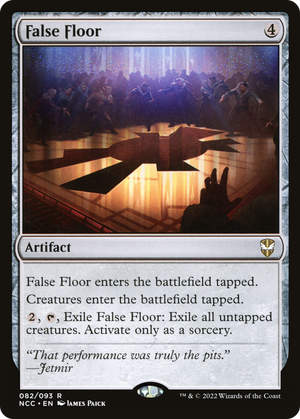
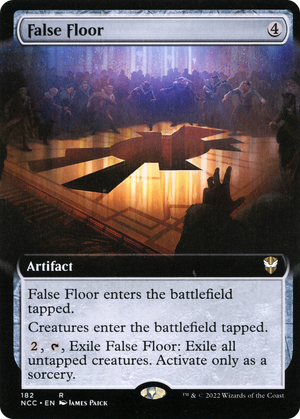
False Floor

Most one-sided board wipes charge a premium for leaving your own side standing; this one flips the terms, taxing both players with a persistent tapped-enter clause, then handing the controller a scheduled reset. The static clause is the engine, not the exile ability. Every creature entering tapped means the board is always split into two populations at any given instant: the summoning-sick and freshly deployed on one side, the untapped and battle-ready on the other. The activated ability only sweeps the second group, which produces a genuinely strange incentive: the untapped creatures, the ones that have had time to settle and are ready to attack, are precisely the ones at risk, while whatever just arrived sits safely sideways. Timing the exile becomes a puzzle of reading who has untapped and who has not; you want it against a table full of held-back creatures, not one that just emptied its hand into an attack, because attackers tap when they swing and are already immune. The sorcery-speed restriction and the exile-the-artifact cost lock this into the planning lane rather than the reactive one: you set it up a turn ahead, then attack with your own board that same turn and fire the ability post-combat, so your creatures sit tapped and survive their own reset. It is useless as a panic button against an incoming attack. Exile instead of destruction is the other quiet strength, denying the death triggers and graveyard recursion that make ordinary wraths a poor answer to creatures built to profit from dying rather than from swinging.
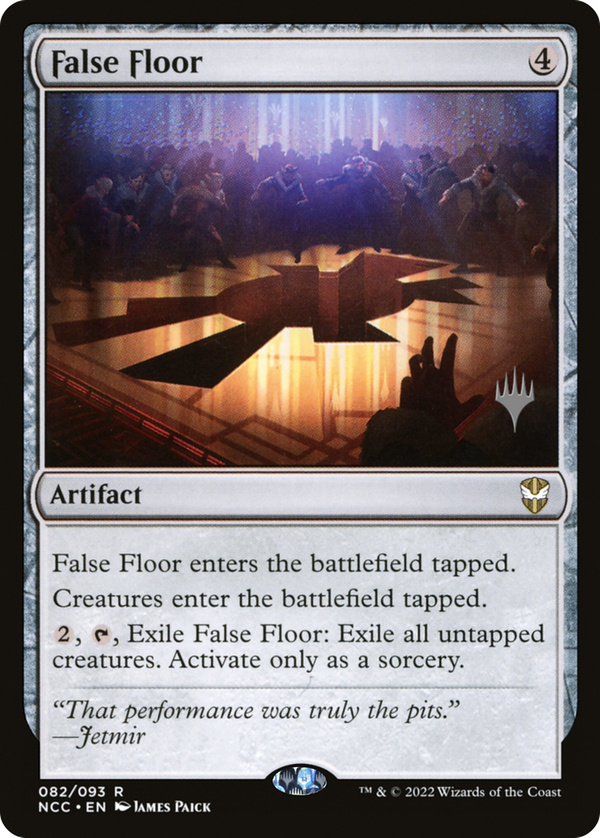
Rules text
 ,
,  , Exile this artifact: Exile all untapped creatures. Activate only as a sorcery.