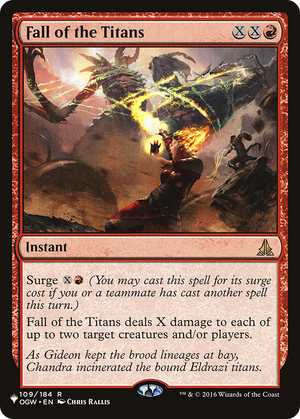
Fall of the Titans


The surge cost is the whole economics here. Paid at full freight, a double-X is a brutally inefficient way to buy damage: you are spending two mana per point of damage dealt to each target, a rate that does not compete with a clean X-spell. The surge clause rewrites that math, but only after you have already committed to a turn that does more than one thing. Cast a cheap spell first (a cantrip, a removal spell, anything) and the cost collapses to , suddenly making each point cost a single mana and the spell a credible finisher or double-removal blowout. That conditional discount is the design's organizing idea: it rewards the player who is already chaining spells, not the player who holds it as a topdeck. The split-damage clause is the second lever, but note its limit: X is dealt to each of up to two targets, so you cannot funnel everything into one mark for 2X. You either spread X across two bodies (or a body and a face) or you settle for a single X, leaving half the spell's reach unused. Surge as a mechanic always asked you to sequence your turn around it, and few cards leaned on that demand as hard as this one, where the gap between the full cost and the surge cost is the gap between a card you cut and a card you build toward. It is a payoff card masquerading as a removal spell, and the payoff only arrives if your deck was already doing the work.
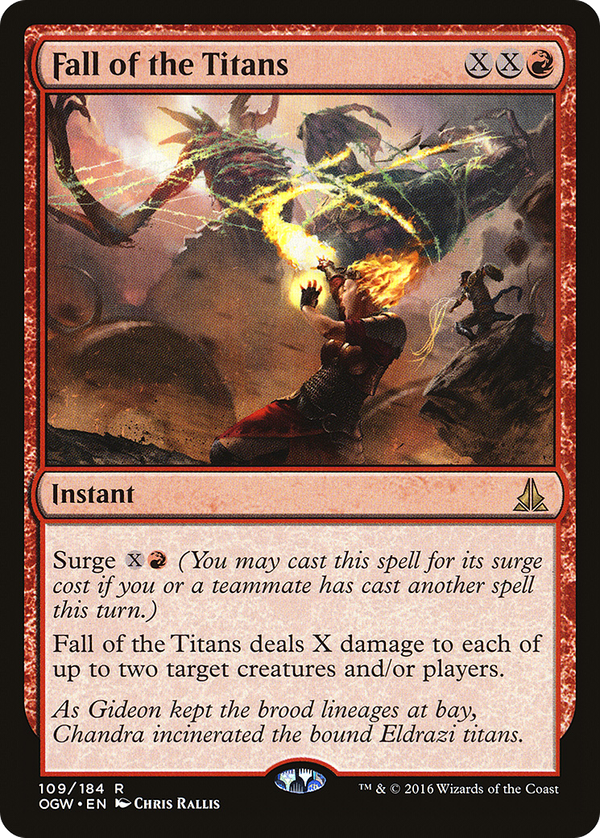
Rules text
(You may cast this spell for its surge cost if you or a teammate has cast another spell this turn.)
Fall of the Titans deals X damage to each of up to two targets.