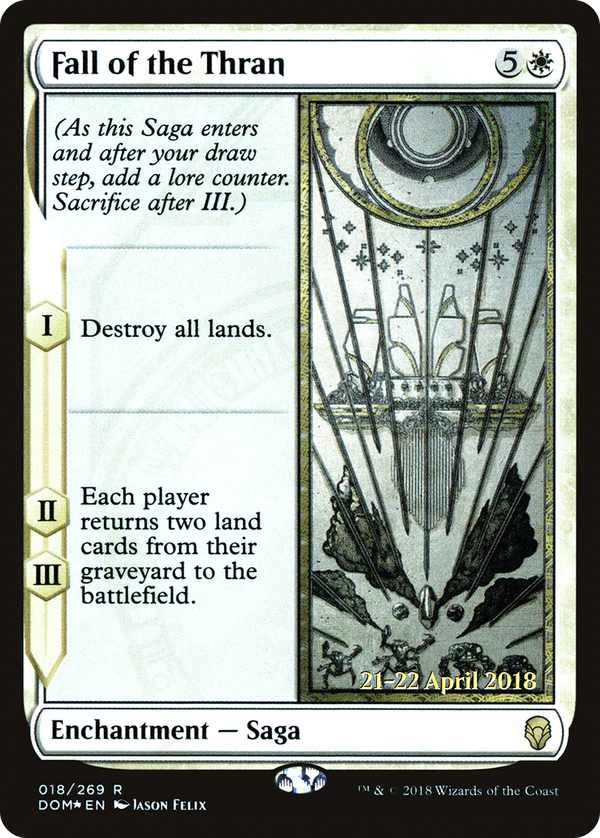
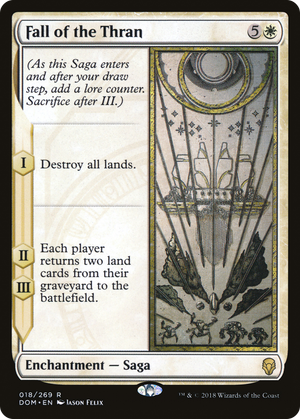
Fall of the Thran


Armageddon with a clock attached, and the clock is what reshapes it. The first chapter does the familiar thing: every land on the table dies at once, the symmetrical wrath that has always lived in white's anti-resource toolbox. But the Saga frame turns a one-shot blowout into a scheduled recovery. Where the older effect leaves both players digging out of a crater, this one dictates the dig: on chapters II and III, each player rebuilds two lands from the graveyard, so the very lands you just destroyed become the kindling for a managed restart. The symmetry of the recovery is where the timing earns its keep. You choose when to fire chapter I, which means you choose who is worst positioned when the lands come back. A player who has already committed threats to the board rebuilds into a working position; an opponent holding a hand of expensive spells and no permanents rebuilds their mana into cards they still cannot cast. The three-chapter arc (the turn it enters, then the next two draw steps before it sacrifices) hands everyone the same two rebuild windows, but only the caster gets to sequence the wipe against a board they have already established. The forced sacrifice means the stall dissolves on its own rather than locking the table forever. It is land destruction redesigned as a tempo swing instead of a scorched-earth stall: the resource wipe is total and shared, but the recovery is legislated, predictable, and tilted toward whoever planned for the morning after.