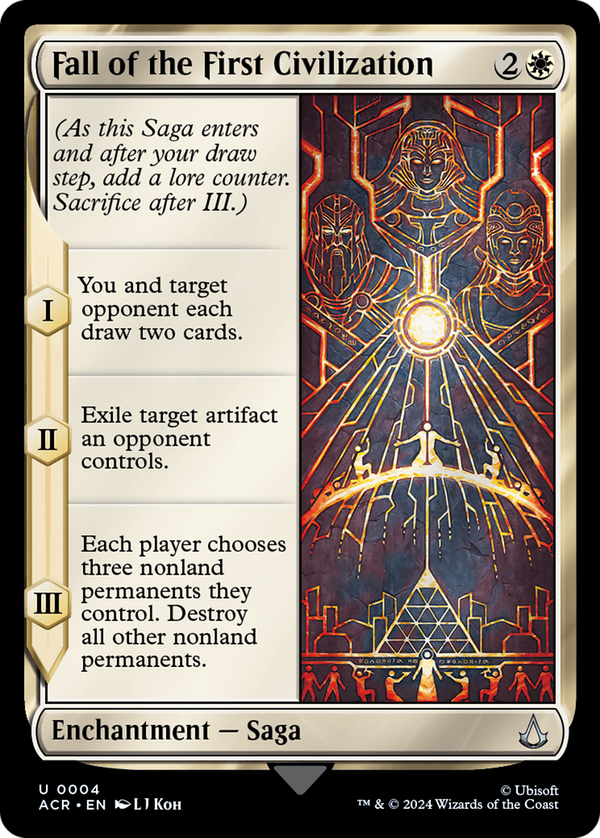
Fall of the First Civilization


A board wipe reframed as a divorce settlement, and the whole design lives in the setup that earns it. The Saga front-loads two chapters that skew increasingly in your favor: I hands both you and an opponent two cards, an even split, but II is pure one-sided disruption, exiling an artifact an opponent controls with nothing owed in return. Those first two turns are less a near-wash than a slow tilt: you break even on cards, then take something for free while the lore counters tick toward the payoff. Chapter III is where the asymmetry cashes out. Rather than sweep everything, it lets each player keep three nonland permanents and destroys the rest, so the wipe is symmetrical only on paper. The player who spent two turns building toward it gets to sculpt what survives (a mana rock, a threat, an engine) while an opponent's overextended board gets pared down to its own best three. Board-in-a-box white has long answered "I fell behind on a wide board" with clean sweepers like Wrath of God; this answers the greedier itch of wanting a Wrath that leaves you a battlefield. The friction is baked into the counter: you have to survive the two chapters first, and because everyone keeps their three best permanents, the wipe punishes width, not quality. It is a sweeper built for the deck that intends to keep playing after the sweeper resolves.