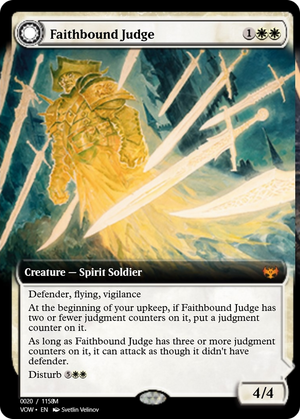
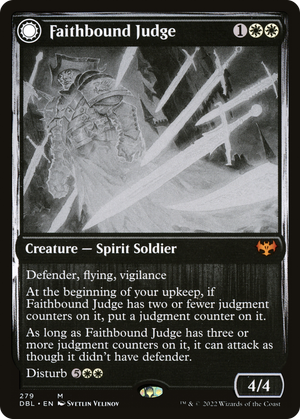
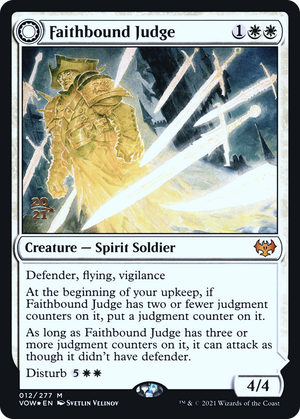
Faithbound Judge // Sinner's Judgment
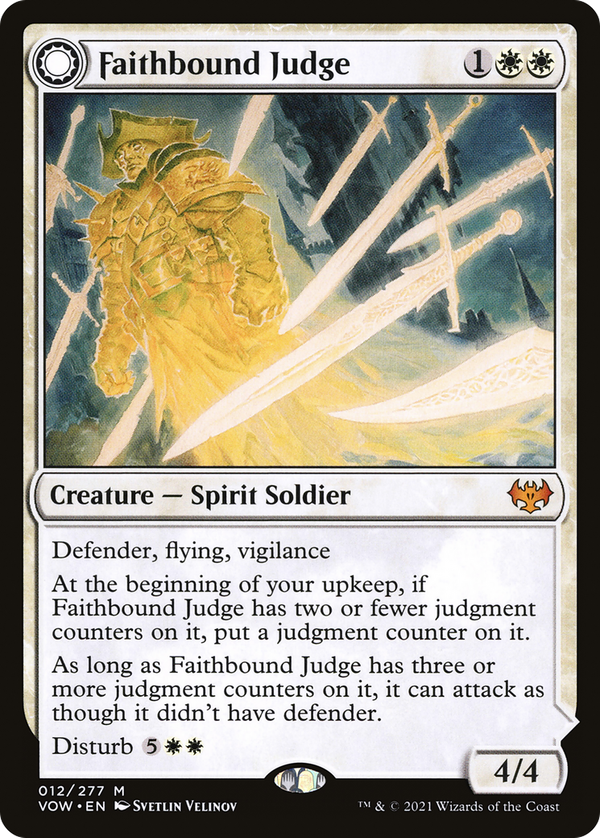
Two clocks in one card, and the design hinges on the fact that they run on opposite sides of the table. The creature half accumulates judgment counters on your own upkeep, sitting behind defender until it has stockpiled three: a self-timing 4/4 flier that turns itself loose without any outside help, no equipment or granted evasion required. Disturb then inverts the whole proposition. Cast from the graveyard as Sinner's Judgment, the same counter engine no longer builds toward an attacker but toward a hard loss condition on the enchanted player, and the exile-replacement clause is what makes it stick. The usual permanent-based answers do not gift the opponent a second Disturb: destroy or sacrifice the aura and it goes to exile instead of the graveyard, closing the door on its own recursion. Bounce is the exception the aura leaves open, returning it to hand as the creature rather than heading to the graveyard, but recasting it means fielding Faithbound Judge again, letting it die, and paying the seven-mana Disturb cost anew—a brutal tempo cost to face the same curse. What makes this more than a two-headed value card is how the front face teaches the mechanic before the back face weaponizes it: three counters is the number, demonstrated on a body slow enough to feel harmless, so that when the curse arrives counting toward the same three, the threat reads instantly. It is an alternate win condition of a kind that rarely gets to simply end the game from nowhere, and the friction is all tempo: three upkeeps is a long window to leave a curse ticking while the opponent races it.
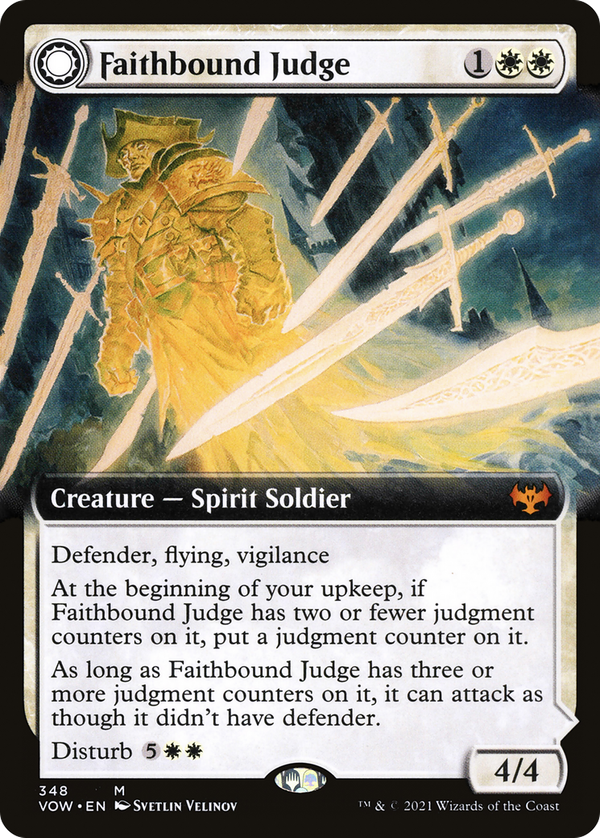
Rules text

 //
Enchant player
At the beginning of your upkeep, put a judgment counter on this Aura. Then if there are three or more judgment counters on it, enchanted player loses the game.
If Sinner's Judgment would be put into a graveyard from anywhere, exile it instead.
//
Enchant player
At the beginning of your upkeep, put a judgment counter on this Aura. Then if there are three or more judgment counters on it, enchanted player loses the game.
If Sinner's Judgment would be put into a graveyard from anywhere, exile it instead.