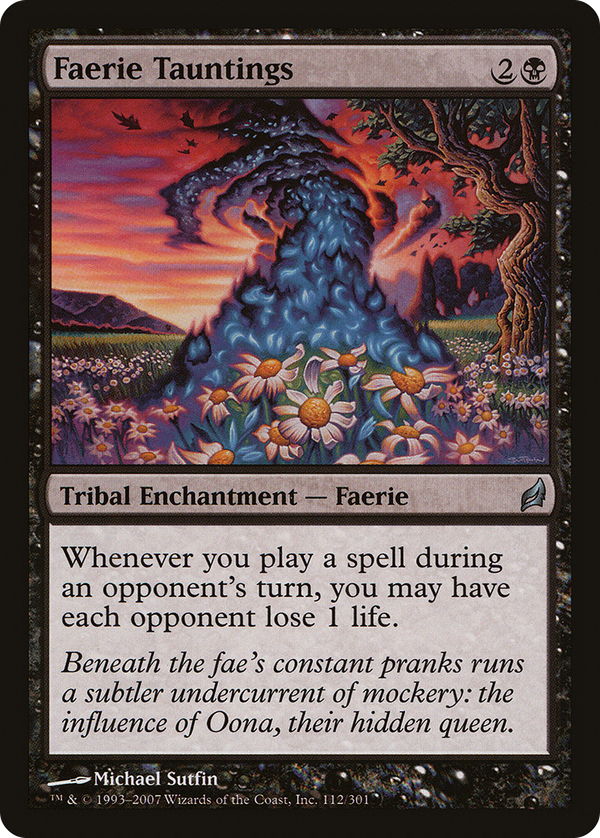
Faerie Tauntings


An incremental drain stapled to a behavioral cue rather than a board state: the trigger fires when you cast during an opponent's turn, which means the card is not asking what you control but how you play. That reframes the whole evaluation. The Faerie type line is mostly window dressing; the engine is the reward for being an instant-speed deck that rarely passes a turn doing nothing. Counterspells, removal, flash threats, end-step card draw: each becomes a one-point lifeloss attached to an action you were already taking. The drain is non-optional in feel but small, so the design discipline lives in the size, not the condition. A symmetrical or board-anchored version of this would warp games; one life per spell on an opponent's turn keeps it a chip-damage clock. And the clock runs fastest against an aggressive opponent, not a passive one: a proactive player deploying threats on their own turn is exactly what pulls counters and removal out of your hand, so each of their developments hands you another trigger. The more the opponent forces you to interact, the more often the enchantment fires. It is a payoff in search of a deck built to hold up mana, the kind of enchantment that idles in a vacuum and quietly closes games once everything around it is operating at instant speed.