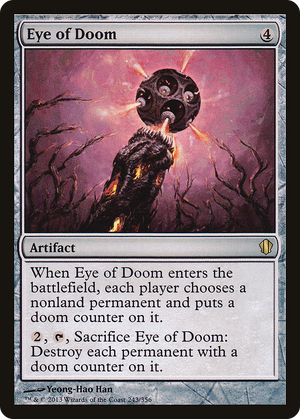
Eye of Doom

What looks like a one-sided board sweeper is actually a negotiation, and the negotiation rarely breaks the way the controller wants. The entry trigger hands every player a vote: each picks any nonland permanent on any battlefield, including someone else's, and the doom counters all wait to resolve into a single later destruction. That shared agency is the entire design tension. The owner gets to mark the scariest thing an opponent controls, but so does everyone else, so the typical sweep becomes a pile-on against whatever the table has collectively decided is the biggest problem, frequently a single overcommitted threat that three players were already eyeing. The card's real leverage lives in the delay. The doom counters land the moment the artifact enters, but the destruction waits behind a sacrifice activation, which freezes the marked permanents into a visible, telegraphed clock. The counters only attach on entry, so anything deployed afterward is safe; the pressure runs the other way, on the players whose best permanent is already wearing one and now has to decide whether to commit more around it or play to a board they may lose at any moment. Reading the moment to crack it is the skill: hold it until an opponent has tapped out behind a permanent they cannot replace, or pair it with your own removal so the counter forces a choice already lost. It is group removal built around distributed targeting rather than the controller's authority, which makes its ceiling the table's appetite for collusion and its catch the same thing: you are never the only one pointing the gun.
Rules text
 ,
,  , Sacrifice this artifact: Destroy each permanent with a doom counter on it.