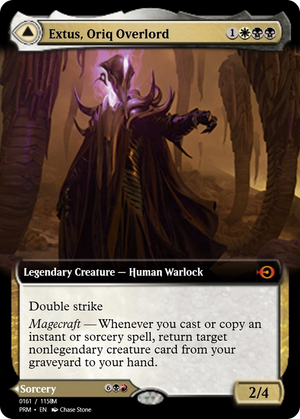
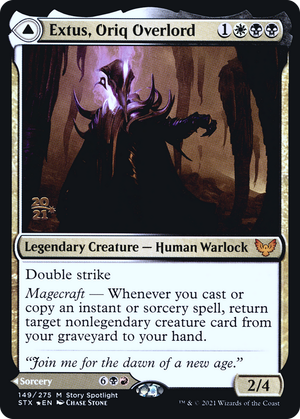
Extus, Oriq Overlord // Awaken the Blood Avatar
The two faces are not two modes of one card so much as two different games it lets you play. The front is a recursion engine: a 2/4 double striker whose magecraft trigger fires whenever you copy or add an instant or sorcery to the stack, dragging a nonlegendary creature card back from your graveyard to your hand. That clause is deliberately fenced. Only nonlegendary, so the card cannot loop legends or, notably, itself. The back is louder. Awaken the Blood Avatar prints a hefty cost, but the sacrifice discount is the real mechanism: each creature you feed it shaves  off the price, so a board full of expendable bodies can conjure the 3/6 hasty Avatar for a fraction of what it reads, forcing every opponent to sacrifice on the way in.
What ties them together is the graveyard math, and both halves lean on the deck to keep the yard and the board stocked. The front fills your hand from the graveyard; the back empties the board to power out the Avatar, and the nonlegendary creatures that die to discount it are exactly the cards the front half wants to buy back. Neither face makes its own fuel: the card is the pivot between a sacrifice-friendly shell and its payoff, spending a wide board on one face and refueling from the aftermath on the other. Split cards had run modal spellcasting long before this, but pairing a triggered-recursion commander with an alternate face that converts a full board into a hasty burn engine is an unusual way to let a single card front an aristocrats deck from either end.
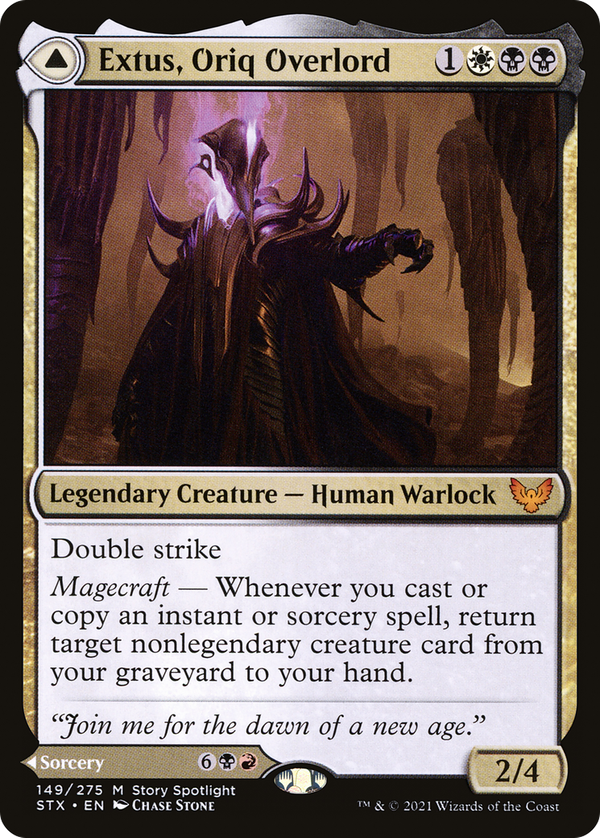
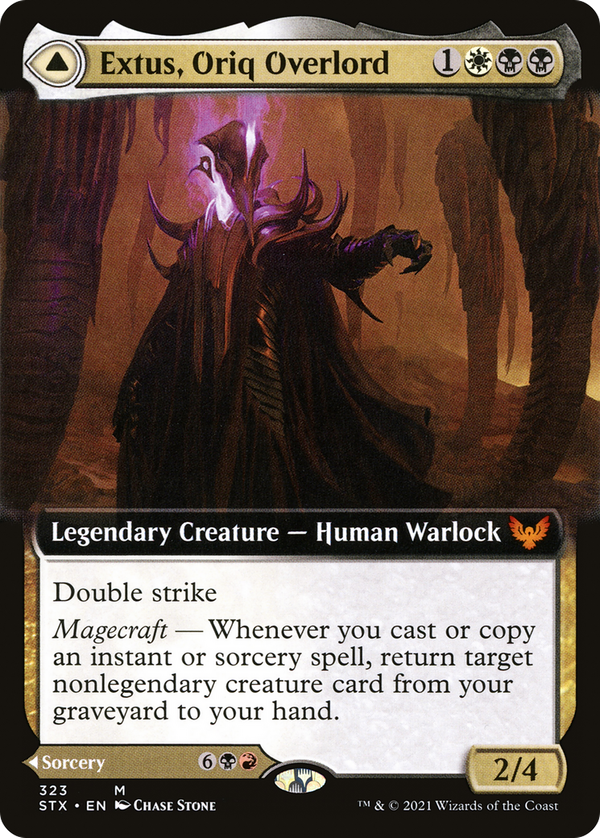
Rules text
less to cast for each creature sacrificed this way.
Each opponent sacrifices a creature of their choice. Create a 3/6 black and red Avatar creature token with haste and "Whenever this token attacks, it deals 3 damage to each opponent."