Excise


Tax-based removal that doubles as a tempo trap: by scaling the exile against a payment of , the card hands the attacking player a price tag rather than a hard answer, and lets them decide whether the committed creature is worth ransoming. The design discipline is the instant-speed window. Cast in the declare-attackers step, after a swing has been committed and the opponent has already tapped out or sunk mana into pumping the attacker, the demand lands when it is hardest to meet. The same effect at sorcery speed would be trivial to play around; here it punishes the overcommitted alpha strike. Exile rather than destroy is the other deliberate choice, sidestepping regeneration and graveyard recursion entirely, which mattered in an era thick with both. The catch is the white-weenie tension baked into the cost structure: you are spending your own mana on to charge the opponent , so the trade is only favorable when you are flooded or when the threat is large enough that the attacker cannot pay. Against a small attacker the spell is dead weight; against a finisher its controller has committed everything to, it is a clean exile for a relative pittance. It is conditional removal whose ceiling and floor are set entirely by board state, the kind of asymmetric-cost answer white kept revisiting long after.
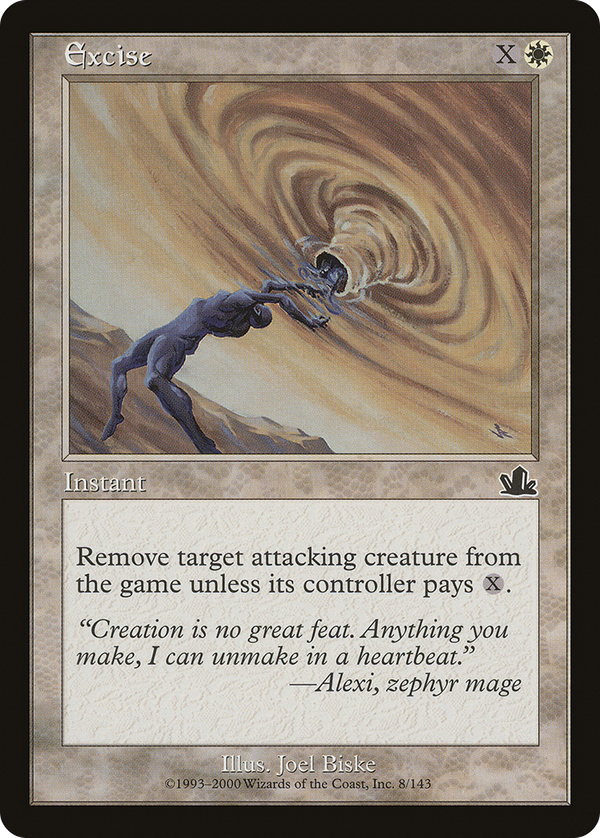
Rules text
.