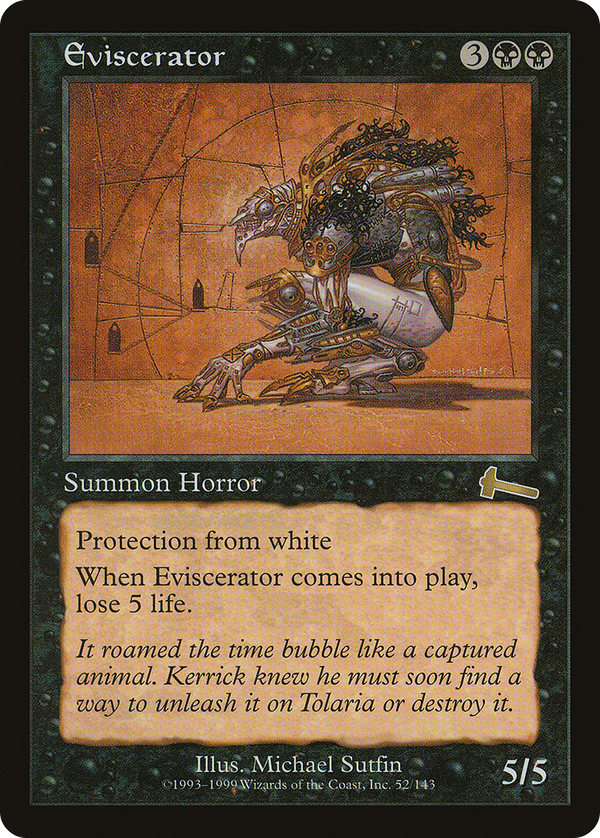
Eviscerator


The five-life payment carries the entire balancing act: a 5/5 with protection from white at five mana would be a flat overstatement of the curve in 1999, so the cost lives in the trigger rather than the casting. You pay for the body after it lands, not before, which inverts how most drawbacks work. A summoning-sick creature usually represents future value you can decline to extend; here the price is collected the instant it hits the battlefield, whether or not the thing ever attacks. That timing is the friction. You cannot get the body cheaper by accepting it later, cannot fizzle the loss by responding, cannot wriggle out once it resolves. The protection from white was the load-bearing keyword in its era, walling off the white removal and the white blockers that a black beatdown deck most feared, and a 5/5 that the most common defensive color could not profitably interact with was a genuine clock. The life loss reads as steep until you weigh it against the alternative of a creature that white could not easily kill or chump for value. This is the bargain black has always offered in its purest form: pay life, get power, no hedging. The Phyrexian Horror flavor does the rest of the work, framing the self-mutilation as the cost of building something monstrous.