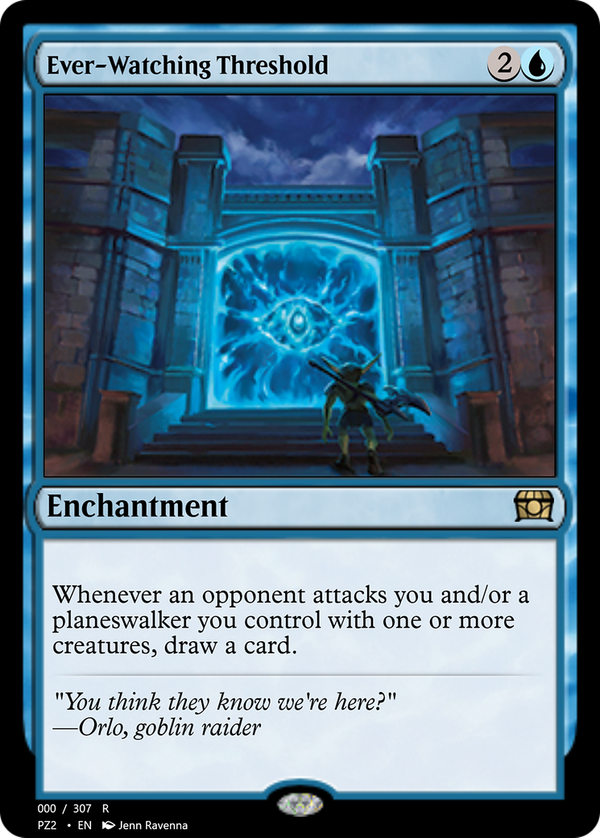
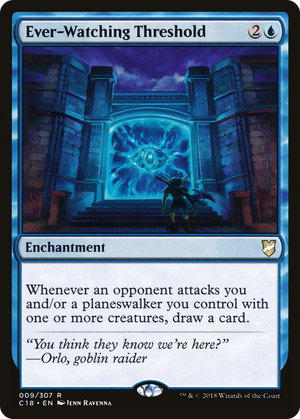
Ever-Watching Threshold


Politics rendered as a card. The pillow-fort tradition (Propaganda, Ghostly Prison) charges a toll to slow attackers down; this inverts the incentive entirely and makes an attack on you profitable. The design leans on a subtle bit of table game theory: it does not prevent aggression, it prices it, so a rational opponent who intended to swing your way now has a reason to swing elsewhere instead. That the trigger checks the declaration of attack, not damage, matters: you draw even when your blocker chumps or the attacker fizzles, and each opponent who keeps testing your defenses hands you another card. The precise condition is what tempers it, though. It reads any attack directed at you or a planeswalker you control, and nothing else. When the beatdown lands on a rival across the table, the condition is not met and you draw nothing. So the card is not a passive engine that profits from a chaotic board; it profits specifically from being the target, which is the exact thing the deterrent effect discourages, and that friction sits at the center of the design. The ceiling is a multiplayer standoff where opponents keep paying to poke at you. The floor is a one-on-one game, where a lone attacker nets you exactly one card per combat and no more, the honest cost of an effect built for the many rather than the two.