Even the Odds


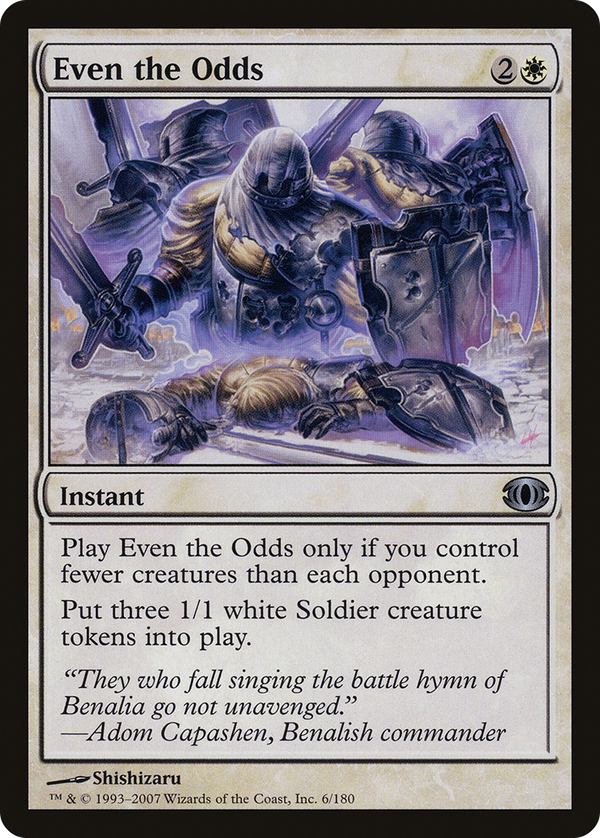
The casting restriction is the whole design, and it points in an unusual direction for white. Most catch-up mechanics are passive concessions: a lifegain payment, a board wipe that hits everybody, a card that ramps the player who is behind. This one weaponizes the deficit directly. The condition gates the spell behind a strict comparison: you cast it only when you control fewer creatures than each opponent, and the payoff is three bodies at once for three mana, a rate that would be plainly undercosted without the lock. The comparison is exact, which carries its own peril: an opponent can deny you the spell entirely by keeping their own creature count low, since you can never have fewer creatures than someone who has none. That makes it a reactive answer to a board that has already committed, not a tool you can rely on against a controlling opponent who never overextends. It sits among a handful of designs that bake the "you are losing" clause into the cost rather than the effect, trading flexibility for a rate priced by gating it behind the game state that makes it fair. The friction is real: in a deck built to flood the board, the spell is dead exactly when you would most want bodies. That tension is the point. It rewards a defensive, attrition-minded shell that lets opponents commit first, then refills at instant speed during a declare-attackers step or end of turn, converting a positional disadvantage into blockers the moment they are needed.