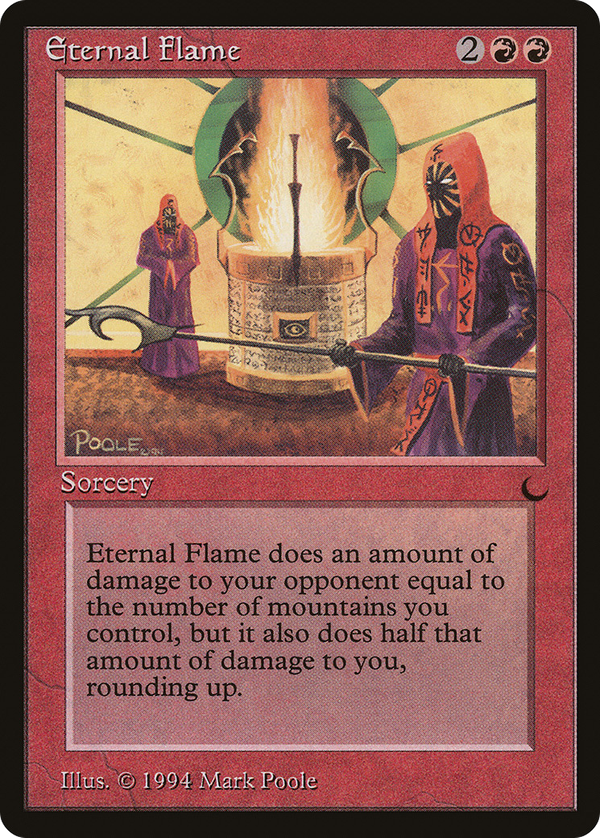
Eternal Flame


The math is the whole story here, and the math is brutal. Damage scales with your Mountains, which means the spell rewards a mono-red commitment so total that running enough Mountains to make it lethal leaves little room for anything else. The self-damage clause is the design discipline meant to hold that scaling in check, and it is a clumsy lever: the damage is asymmetrical (you take half what you deal, rounded up), but the curve is steep enough that any swing large enough to close a game also puts the caster on a clock. That self-bleed is a hallmark of mid-90s red, when forcing the caster to pay life or take damage was the standard way to let a payoff grow large; the same instinct shows up across the era's bigger burn. What dates Eternal Flame further is the targeting: it hits an opponent or planeswalker, never a creature, so it can pressure a planeswalker but does nothing about the rest of the board. The result is a finisher with no flexibility and a demanding setup, fragile because anything that strips your Mountains (land destruction, in the era this was built for) directly shrinks its output. It is the early, unrefined version of "your lands are your damage," an idea later designs would express with far more economy and far less self-harm.