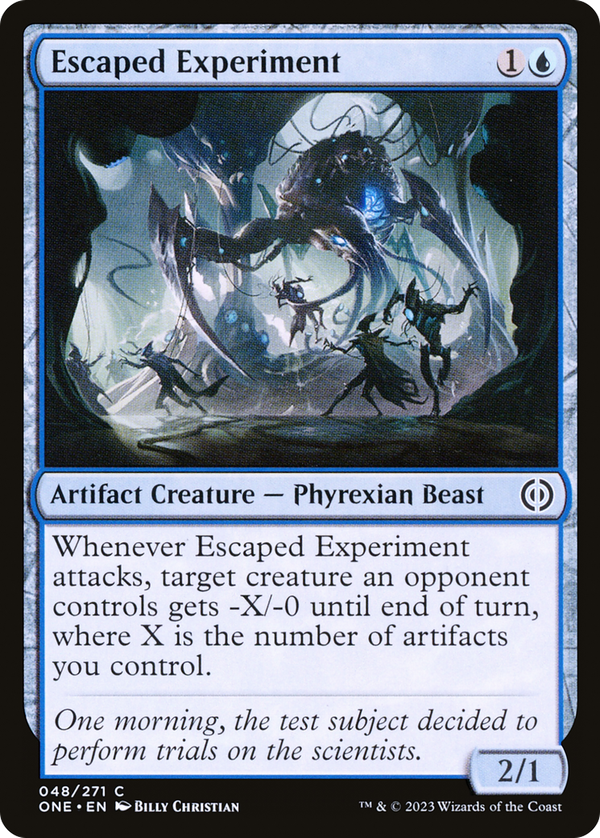
Escaped Experiment


The design tension lives entirely in the -X/-0 clause, and it is a deliberate refusal to let this be removal. Shrinking power instead of toughness means the attack trigger never kills; it clears a path. The window matters as much as the effect: the debuff fires when this attacks and expires at end of turn, so it lands squarely on a would-be blocker and is gone before the opponent's own combat phase. That makes it a one-directional tool, an escort service for the swing rather than a defensive deterrent. A creature that could trade with the incoming 2/1, or gang up on a bigger board of your artifacts, gets its power hollowed out for exactly the length of your attack and returns to full size afterward. The scaling reads as an artifact-matters payoff, and it is, but the payoff is narrow by design: the more artifacts you assemble, the more reliably you can pick one blocker and make it decline the fight, without ever actually removing it. The count you build up converts into recurring combat manipulation, resetting each turn rather than sticking, which keeps a cheap body with a potentially enormous trigger from becoming a repeatable execution. It asks a deck already flooding the table with cheap artifacts to translate that density into a threat that punches through, sitting on a frame small enough to slip past the survivors in exactly the games where the trigger scales highest. A creature that dictates the attack step without ever settling the board.