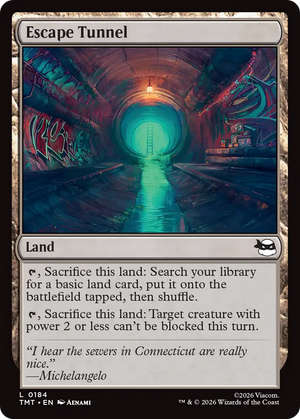
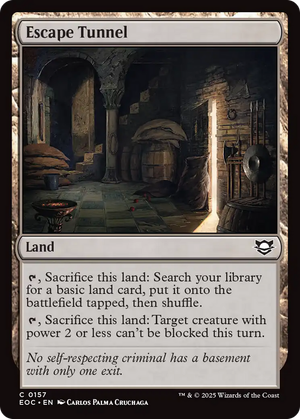
Mana fixing for two-color TMT decks that want a free splash or a bit of deck thinning, with a sacrifice-mode chip-through stapled on for later. The second mode lines up better than usual here: Sneak is the set's most common mechanic, and a turn where you push a one-power creature through to trigger an Alliance or a ninjutsu-style swap can matter. Still, the modes compete for the same land, and most games you crack it for the basic. Take it after your playable colored commons, earlier if you are stretching to a three-color legendary build.
Escape Tunnel
Land
Format takes
How this card plays
8 reviews
The unblockable rider is what separates this from Evolving Wilds, and it only matters in a narrow band of decks: the ones built around connecting with a small evasive creature to trigger something downstream. Yuriko, the Tiger's Shadow is the cleanest fit. Ninjutsu wants a low-power body to slip through unblocked, and the second mode buys that window on a turn when opponents have finally found enough blockers to wall the early aggression. The clamp at two power or less is the point: this is not pushing a commander through for lethal, it is letting a one-power ninja connect to fire a Yuriko reveal. Saboteur shells that care about a single hit landing, rather than about combat damage as a finisher, get the same use.
This is a Bracket 2-3 card, and the budget is the whole story: bulk, sub-$1, the kind of include that lives in casual lists already running Evolving Wilds and Terramorphic Expanse. The role is fixing first, with the rider as a banked trick you spend on the turn the connect matters. The cost is that you sacrifice the land for either mode, so you commit one tapped basic-fetch's worth of value to a single use, and in two-color Yuriko you are fetching one of two basics rather than fixing a real splash.
Against the fixing slot, it loses to fetch lands and duals on raw mana quality in any optimized list. Where it competes is the one-power-matters shell already running the worse tapped fetches; there it is a strictly better Evolving Wilds, since the second mode is free upside. Outside that shell, the unblockable line never comes up, which is most Commander tables.
The colorless utility land slot is the contested one in Modern, and the incumbents there are unforgiving. Decks that want a tapped fetch already run Evolving Wilds or, more often, do not run it at all because Modern's manabases are built around shocks and fetchlands that produce untapped on turn one. The first mode here is Evolving Wilds with a worse name, and Evolving Wilds itself barely sees Modern play because entering tapped is a real cost in a format this fast.
The second mode is the pitch: a stored unblockability trigger for a creature with power two or less. The natural home would be a ninjutsu shell, where pushing a one-power evasive beater through to connect enables the bounce-and-replay engine. But the Dimir-flavored ninjutsu decks in Modern have not stabilized into a tracked archetype, and the ones that flirt with it lean on actual flying or unblockable bodies rather than a land that sacrifices itself for a single chip-through. The cost is the problem: spending a land and its mana to make a two-power creature unblockable once is a steep rate when the land entered tapped to begin with.
So the choice the card is built around, fix now or connect later, is a clean design idea attached to two modes Modern already does better elsewhere. It is legal but has yet to register in tracked tournament play this season, and the structural read explains why. The unblockability clamp at power two keeps it out of finisher decks, and the tapped-fetch mode keeps it out of the manabases that could afford the land slot. No active Modern home.
Tracked Standard playas of Jun 2, 2026
Registered in 14.2% of tracked decks, 3.5 copies on average, 77 Top 8 finishes. Last seen May 31, 2026.
A tapped basic-fetch land for two-color Standard decks that want a free deck-thinning slot and occasionally a chip-through enabler, currently a regular role-player rather than a defining one. The mana mode is Evolving Wilds, and most decks running this play it for that mode alone; the unblockable rider is upside the deck rarely cashes in. Decks tend to run it as a multiple-copy fixing piece, not a one-of trick. Cut for an untapped dual or a more relevant utility land when the fixing is not load-bearing.
A tapped fetch for a basic that can instead spend itself to push a small creature through once: the kind of seam-stitched utility land that reads better in the abstract than it plays in a tournament. It is legal in Pioneer but has yet to register in tracked tournament play so far this season, and the reason is structural rather than a matter of time.
Pioneer's evasion shells do not want this. Azorius Spirits already flies over the ground and has no use for an unblockability rider on a land. The ninjutsu plan that the second mode flatters never assembled into a Pioneer deck; there is no tournament-viable ninja archetype here for the late-game chip-through to enable. And the decks that do want a fetch-a-basic land, the ones reaching for Evolving Wilds or Fabled Passage, are running it to enable a color or to feed Lotus Field and revolt triggers, none of which pay extra for a combat trick they will rarely fire.
That leaves the card competing with Evolving Wilds for the worst version of the same slot: the same tapped fetch, the same shuffle, plus a rider that the decks running tapped fetches have no creatures small enough or evasive enough to use. The clamp at power two or less means it cannot push a real finisher, and the decks built around one-power beaters do not exist in the current Pioneer map. The archetype that would justify the second mode has not been built, and the first mode is already covered better.
Tracked Pauper playas of Jun 2, 2026
Registered in 2.0% of tracked decks, 3.1 copies on average, 11 Top 8 finishes. Last seen May 29, 2026.
The fixing mode is Evolving Wilds with a rider, and Evolving Wilds is the incumbent it competes with directly: a tapped basic-fetch that smooths a two- or three-color manabase and feeds the graveyard for delve. Pauper's fetch-style lands are mostly interchangeable, so the question for any of them is what the rider buys you. Here it is an unblockable clamp for a creature with power two or less, which in this format is the language of ninjutsu and small evasive beaters rather than a finisher push.
That keeps the card honest. The second mode lands a one-power body for a connect on turn six, not a lethal swing, and it costs the land to do it. The choice between fixing now and banking the chip-through later is real, but in practice the fixing is the reason most lists run it, with the rider as occasional upside in a tight game.
In the format's tournament rotation it shows up as a role-player rather than a fixture, and where it appears it tends to run near a full set in the manabase slot Evolving Wilds would otherwise hold. It sits under a tix on MTGO, in the same negligible band as every other common fetch effect. The honest read: a lateral move over Evolving Wilds for most decks, a small upgrade for the specific shells that want a connect, and a slot only those shells will trouble to run.
A tapped fetch for a basic in a format where Black Lotus makes three mana for free on turn zero and the Moxen tap for one the moment they hit. Evolving Wilds has never been a Vintage card, and the unblockability rider for two-or-less power does nothing the format asks for. Legal, but yet to register in tracked tournament play. Noise.
Tracked Legacy playas of Jun 2, 2026
Registered in 0.1% of tracked decks, 1.0 copies on average. Last seen Apr 25, 2026.
The fixing mode is Evolving Wilds, which Legacy passed over a decade ago: the format's manabases fetch dual lands and shocks with Polluted Delta and friends, not basics that arrive tapped. The unblockability mode is the only thing that might earn the slot, and the competition there is what a small-creature deck already runs to connect. A Delver shell wants Wasteland and untapped fixing in its land slots, not a land that taps and sacrifices itself for one chip-through, and the two-or-less power clamp keeps it off the beaters that actually close games. Wasteland at zero, plus the fetch-dual manabase, leaves no room for a land whose best mode is a single one-shot evasion trick. A fringe presence in tracked Legacy this season at most, and that does not clear the bar.
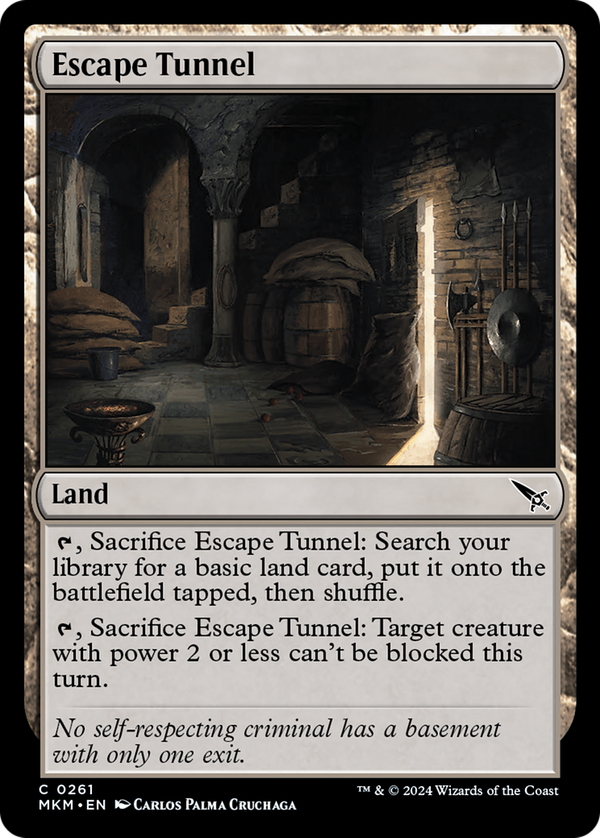
MKM · #261common
Pricing
Normal: $0.26
Foil: $0.36
Oracle Text
Rules text
 , Sacrifice this land: Search your library for a basic land card, put it onto the battlefield tapped, then shuffle.
, Sacrifice this land: Target creature with power 2 or less can't be blocked this turn.
, Sacrifice this land: Search your library for a basic land card, put it onto the battlefield tapped, then shuffle.
, Sacrifice this land: Target creature with power 2 or less can't be blocked this turn.Legalities
Format Status
Standard
Legal
Pioneer
Legal
Modern
Legal
Legacy
Legal
Vintage
Legal
Commander
Legal
Pauper
Legal
Brawl
Legal
Historic
Legal
Alchemy
Legal
Timeless
Legal
Standard Brawl
Legal
More formatsFewer formats
Old School
N/A
Premodern
N/A
PreDH
N/A
Pauper Commander
Legal
Oathbreaker
Legal
Gladiator
Legal
Penny Dreadful
Legal
Duel Commander
Legal
Future Standard
Legal
COMPETITIVEBRAWL
Legal
TLR
Legal
Printings elsewhere
Other printings
2 sets