Eris, Roar of the Storm



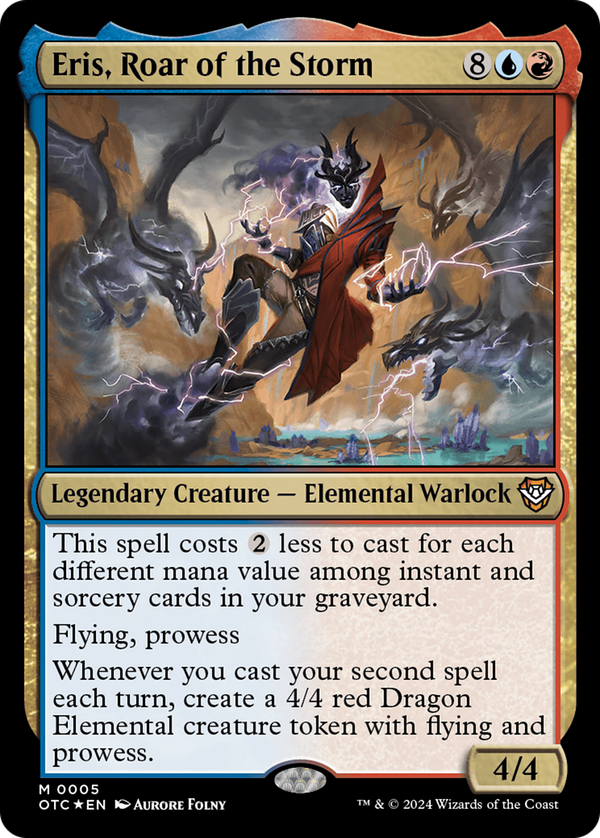
The printed ten mana is a fiction, and the reduction clause tells you why: it reads off different mana values among your instant and sorcery cards in the graveyard, not the raw count. That distinction reframes the deckbuilding problem entirely. You are not maximizing spell density; you are maximizing the spread of costs. A graveyard holding one-, two-, three-, four-, and five-drops shaves ten mana; a graveyard stuffed with ten copies of the same one-mana cantrip shaves two. The math pushes toward a toolbox with deliberately staggered rungs rather than a pile of redundant cheap effects, which is nearly the opposite of what a pure storm shell wants. Red-blue spell payoffs have historically rewarded velocity: cast a lot, cast fast, chain into a kill. Reducing off variety asks for a curve that touches many points instead of hammering one, and that inversion is what makes this a distinct place in the spellslinger lineage. The 4/4 flier with prowess is almost incidental once she resolves; the second-spell trigger is the actual payoff, spawning a 4/4 Dragon with its own flying and prowess every time you fire a second cast in a turn, so the board widens as fast as the spells burn. She is a spells-matter finisher that rewards a graveyard organized like a well-stocked cabinet rather than a landfill.
Rules text
 less to cast for each different mana value among instant and sorcery cards in your graveyard.
Flying, prowess
Whenever you cast your second spell each turn, create a 4/4 red Dragon Elemental creature token with flying and prowess.
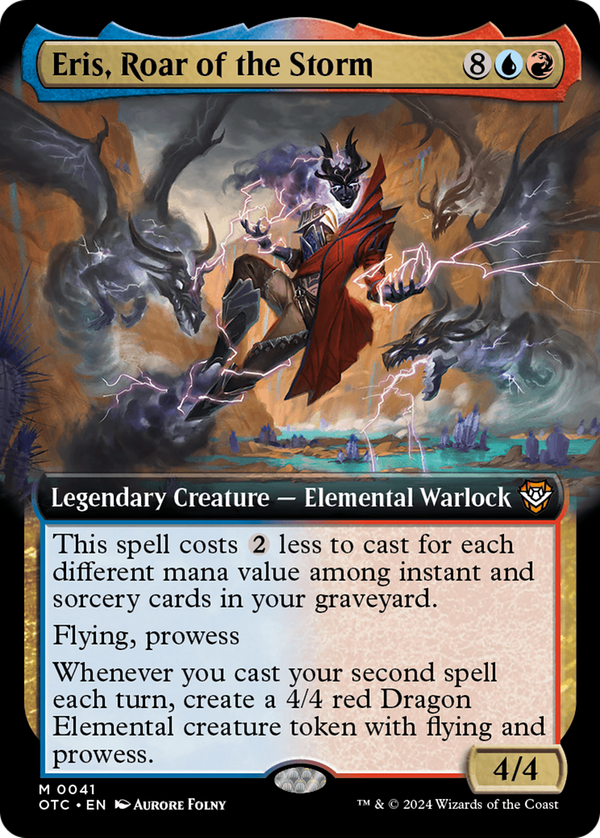
less to cast for each different mana value among instant and sorcery cards in your graveyard.
Flying, prowess
Whenever you cast your second spell each turn, create a 4/4 red Dragon Elemental creature token with flying and prowess.