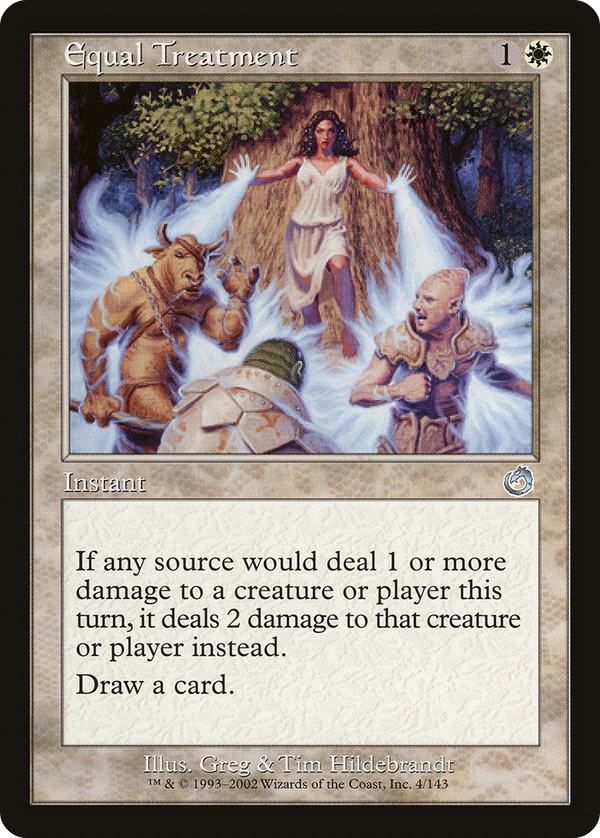
Equal Treatment


Read the line slowly and the trap inside it surfaces: this does not double damage, it pins every source to exactly 2. A subtle but total difference. For a source that would deal 1, the effect is a buff, turning a one-power poke at a planeswalker into a two-point bite or rounding incidental damage up past a lethal threshold. Aim it at anything dealing 3 or more, though, and the number collapses downward: a three-damage burn spell shrinks to two, a fat attacker's strike gets capped, a big swing loses its teeth. The symmetry runs the opposite direction from a real combat pump, which is why fixing damage to 2 against an opponent's burn or a heavy hitter functions as a fog-adjacent defensive tool rather than an amplifier. The deck that wants this is hunting for the turn where flattening every source to 2 nets out positive, most often a wide board of one- and two-power creatures crashing in: the twos hold their damage, the ones round up, and the math tips. The cantrip is what pays for that narrowness. White rarely gets effects this conditional without a rider attached, and here the replacement card is the rider; even on a turn where the equalizing accomplishes nothing, you drew, you spent two mana, you moved on. That is the bargain an early-era cantrip-with-a-clause strikes: a situational, easily-blanked effect, priced so it is never quite a dead draw.