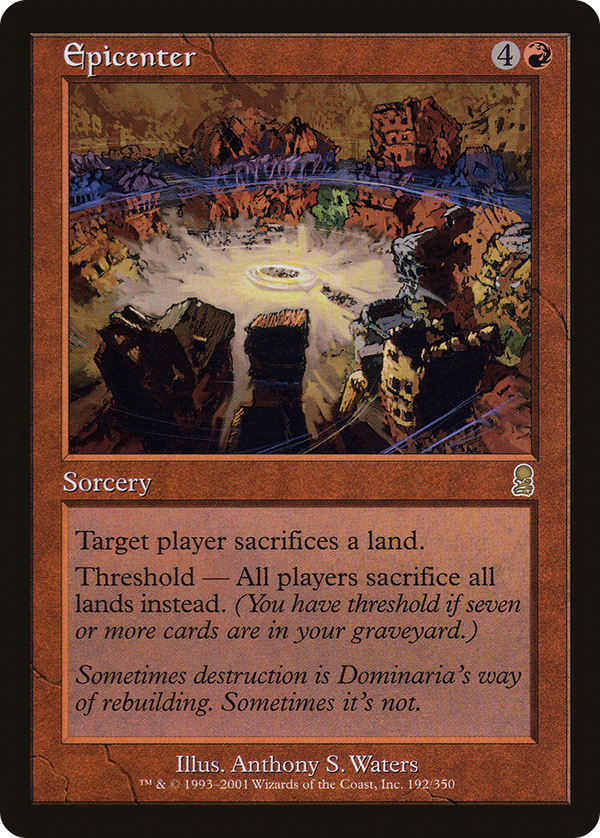
Epicenter


Land destruction with two settings, and the threshold clause is the dial between them. Cast it early and you get a single, polite land kill: the targeted player picks which land dies, a tempo nudge that respects the opponent's choice. Stock seven cards in your own graveyard first and the spell mutates into a one-sided apocalypse dressed in symmetrical wording: everyone, you included, loses every land. The design wager is that by the time your graveyard runs that deep, you are either a dedicated land-light deck that can rebuild faster or a deck whose business is settled before mana matters again. That asymmetry-through-symmetry is the trick: the card reads as fair (each player sacrifices), but the precondition is yours alone to satisfy. It belongs to the early-era spells that printed two cards in one and let the graveyard count decide which you got, and the payoff here runs harsher than most, since the off-switch is real removal and the on-switch resets the entire game's resource base. The friction is the obvious one: five mana to set yourself back as far as everyone else unless your deck is built to survive the wasteland it creates. That constraint is precisely why it never became a casual blowout and stayed the property of decks willing to burn down the house with themselves still inside it.