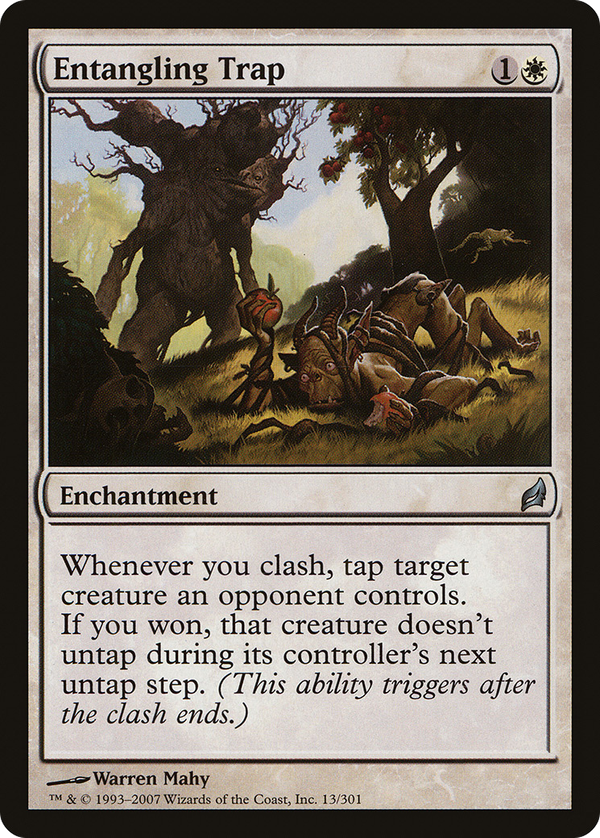
Entangling Trap


Clash was a coin-flip dressed up as a decision: reveal the top card of each library, compare mana values, then keep that card on top or bury it. The mechanic struggled to find homes because the payoff usually amounted to a card-selection nudge wrapped around a variance engine. This enchantment is what happens when a designer hangs a Tangle Wire-style tempo effect off that trigger. Every clash taps down an attacker or blocker; come out ahead, and the creature also misses its next untap step, stretching a one-turn tap into a two-turn lockdown. It is more reliable than the variance suggests, because the outcome is decided by the mana values revealed, not by the top-or-bottom choice that follows: you cannot steer a single clash, but a deck with a tuned curve can stack the comparisons in its favor. What undercuts it is the parasitism. With nothing on the battlefield or in your spells generating clashes, this sits inert, and even when it fires, the lockdown only matters in a strategy built to attack while one defender stays sideways. It is a tempo card masquerading as removal, asking you to weaponize a mechanic engineered to feel optional. As a snapshot of an early attempt to tie repeatable battlefield effects to library manipulation, it is more instructive than it ever was powerful.