Enraging Licid


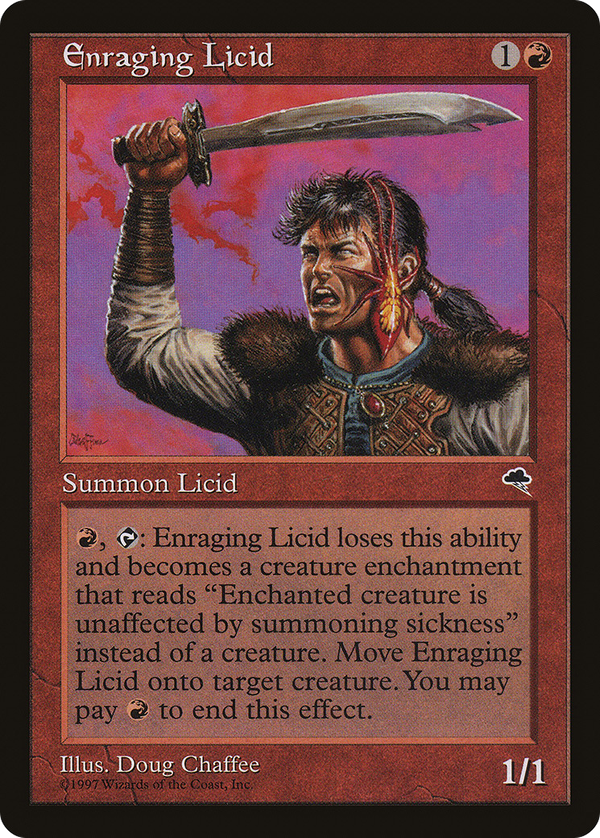
Tempest's designers spent a slot in every color on a single audacious idea: a permanent that toggles between being a body and being an Aura, paying its conversion ability away as the price of admission. Here the granted effect is haste, and the toggle is the entire pitch. Tap the 1/1 and it changes type in place, becoming an Aura that attaches to a creature that just landed so it can swing immediately; then, whenever you like, pay to end the effect and return it to being a creature before the host dies under it. A standard Aura sinks with whatever it enchants. This one reverts at its controller's discretion, a structural advantage no static haste-granter of 1997 could match. Losing the activation ability once it converts is the friction the whole interaction is built around: it stops the trick from looping for free. The Licids never broke through, in part because their rules were a notorious tangle. They predated clean templating for state-changing permanents, and judges spent years arbitrating what happened when the host left play or the toggle was reverted mid-combat. The concept (a card that decides each turn whether it is a creature or an enchantment, without ever leaving the battlefield) was sharper than the rules engine that had to enforce it, and the cycle reads now as a design idea arriving a decade ahead of the templating that could have carried it cleanly.
Rules text
,  : This creature loses this ability and becomes an Aura enchantment with enchant creature. Attach it to target creature. You may pay to end this effect.
Enchanted creature has haste.
: This creature loses this ability and becomes an Aura enchantment with enchant creature. Attach it to target creature. You may pay to end this effect.
Enchanted creature has haste.