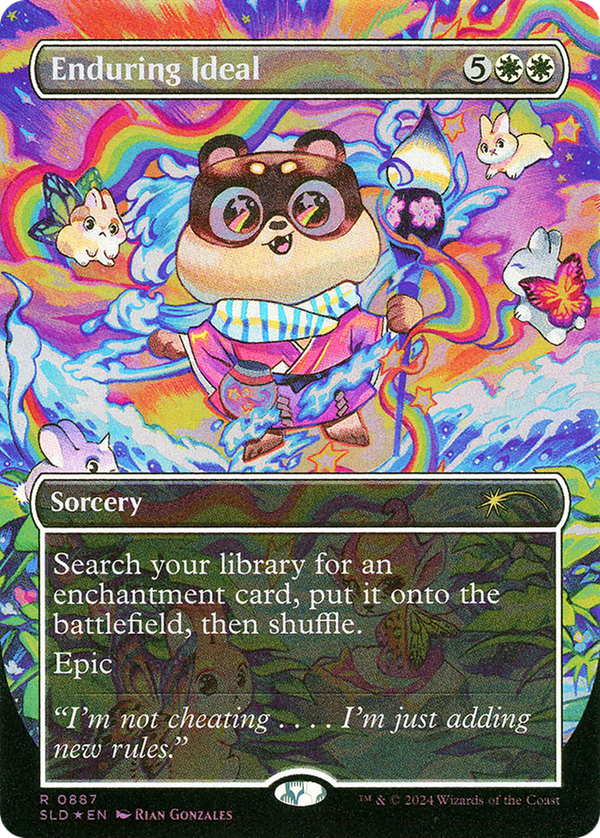
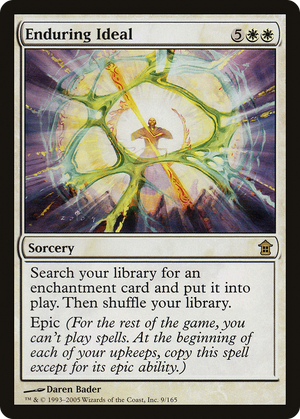
Enduring Ideal


Epic was the keyword that asked players to fall on their own sword: cast this once and you never cast another spell again, with each upkeep handing you a copy until the game ends. Most of the cycle this mechanic belonged to never escaped jank, because trading your entire future spellcasting for a repeated effect is a brutal bargain. This is the one that justified the cost, because the thing it copies forever is an enchantment tutor that puts the card straight onto the battlefield. The first cast fetches a game-ender; every upkeep after fetches another, and the chain only stops when your library runs out of enchantments or the game does. Because the copies skip the epic clause, each one just searches and cheats without re-imposing any penalty, so the engine builds toward an inevitable enchantment-based lock or kill. The genuine tension is in the curve of the search: you commit knowing you can no longer interact through spells, which means the enchantments you fetch have to carry all your defense, all your card advantage, and all your win condition, with nothing left to hold up at instant speed. It rewards a toolbox of permanents that win by simply existing rather than by being cast in response to anything. The result is a sorcery that functions less like a spell and more like flipping the game into a different mode, where your turns become a tutor that never misses and never stops.