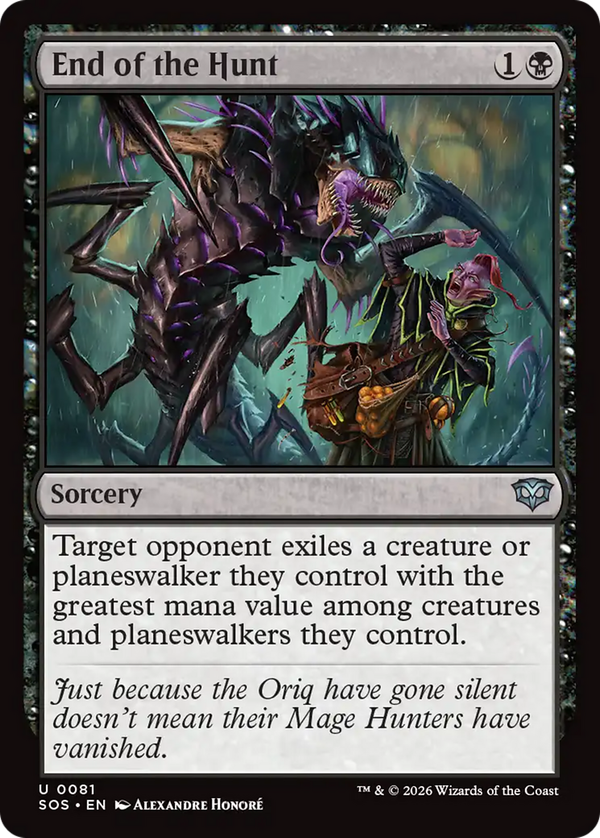
End of the Hunt


Edict effects have always been the answer to problems you cannot target: hexproof threats, resolved planeswalkers, whatever the opponent is protecting with shroud or a bodyguard. The classic version (Diabolic Edict, Chainer's Edict, Geth's Verdict) lets the opponent choose which permanent dies, which is why they punt into empty boards and get sandbagged behind a chump. End of the Hunt flips the selection rule: the sacrifice becomes an exile, and the opponent must give up their most expensive creature or planeswalker rather than their least. That single word ("greatest") reroutes the whole spell. Against a deck built around one enormous threat, it is a clean two-mana answer that cannot be redirected onto a token, and exile denies recursion and death triggers that a sacrifice clause would happily hand out. The cost is precision: it is still blind to the specifics, so when the opponent's biggest thing is a mana rock's worth of value rather than the creature you actually fear, the spell can peel off the wrong permanent. That trade (constraining the opponent to their highest mana value, but ceding the choice of which category) is the design tension the whole card lives inside. It is the edict rewritten for a world where the scariest thing on the board is usually also the most expensive one.