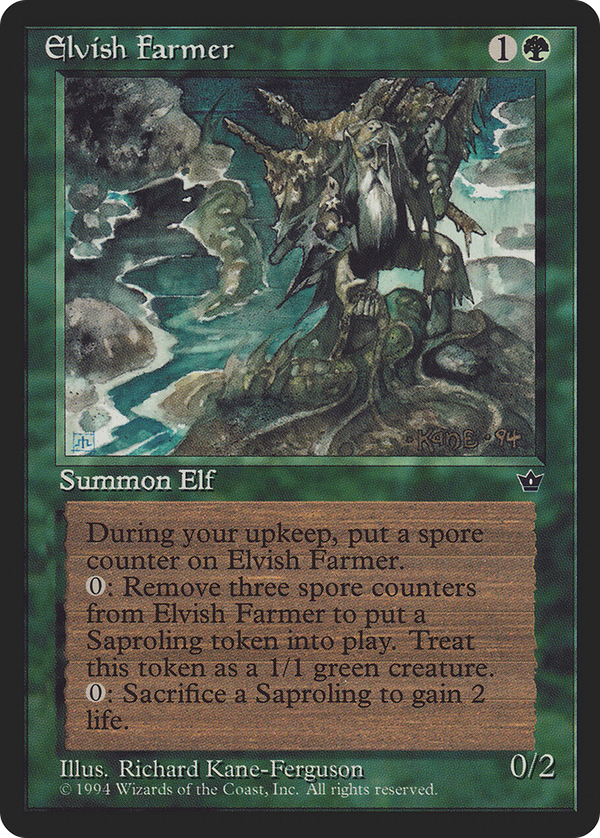
Elvish Farmer


Where spore counters made their debut, and a study in how heavily 1994 design taxed an incremental life engine. The whole machine runs on a clock the card builds for itself: one spore counter every upkeep, three counters spent to spit out a single Saproling, then a sacrifice clause that converts each token into two life. That is three upkeeps before the first token exists, and because the Saproling can be fed to the life clause the instant it arrives, three upkeeps before any life gain, all carried by a 0/2 body that does nothing else in the meantime. Each step gates the next, a closed loop with no acceleration anywhere inside it, which is why nothing about the rate respects the tempo of a game already in motion. What it documents is the early-design assumption that grindy, repeatable life engines needed punishing setup costs to exist at all, a caution Wizards has steadily relaxed as Saprolings grew into a recurring fungus theme across green and black. The token itself is the durable inheritance: the Saproling creature type outlived the painstaking contraption that first generated it, recurring across decades of fungus and go-wide strategies. As game history, this is the seed of a mechanical lineage. As a functioning card, it asks you to wait several turns before it begins trickling out anything at all.