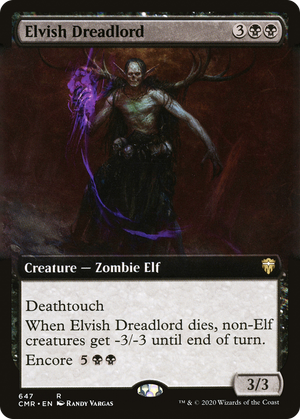
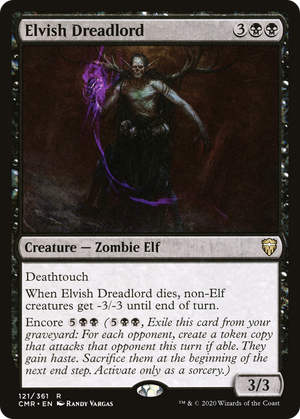
Elvish Dreadlord


The design tension here is that its board wipe is bolted to its own death, and encore is the mechanism that guarantees delivery. A creature that gives non-Elf creatures -3/-3 when it dies is only useful if you can reliably make it die on your terms; sitting on the battlefield, its 3/3 deathtouch body is a fine deterrent, but the sweep sits inert. Encore resolves that problem from the graveyard, at the cost of exiling the card as part of the activation: for each opponent, you get a token copy that attacks, and each of those copies is sacrificed at the beginning of the next end step. That sacrifice is not a drawback, it is the payload. Every token dies on cue, and every death fires the -3/-3 trigger, so a table of three opponents means the wipe resolves three times in a single turn, stacking to -9/-9 and clearing all but the highest-toughness non-Elf blockers and attackers before anyone gets a counterattack. Because encore exiles the card, that multi-opponent detonation is a one-shot finisher, not a recurring engine: you spend the graveyard copy once, and it goes wide all at once. The tribal exclusion is what earns the self-destruct clause: your Elves survive the sweep, so the card sits at the top of an Elf shell that shrugs off its own kill spell. It reads as a midrange beater and functions as a delayed, scaling sweeper delivered from the graveyard, a different card entirely from the one on the front of the type line.
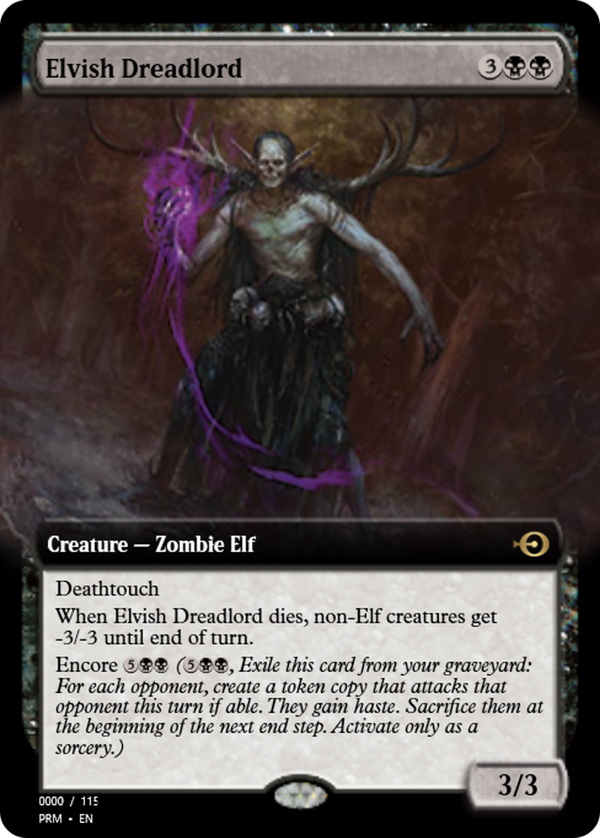
Rules text
 (, Exile this card from your graveyard: For each opponent, create a token copy that attacks that opponent this turn if able. They gain haste. Sacrifice them at the beginning of the next end step. Activate only as a sorcery.)