Elephant Grass

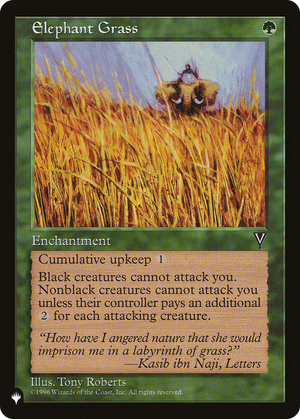
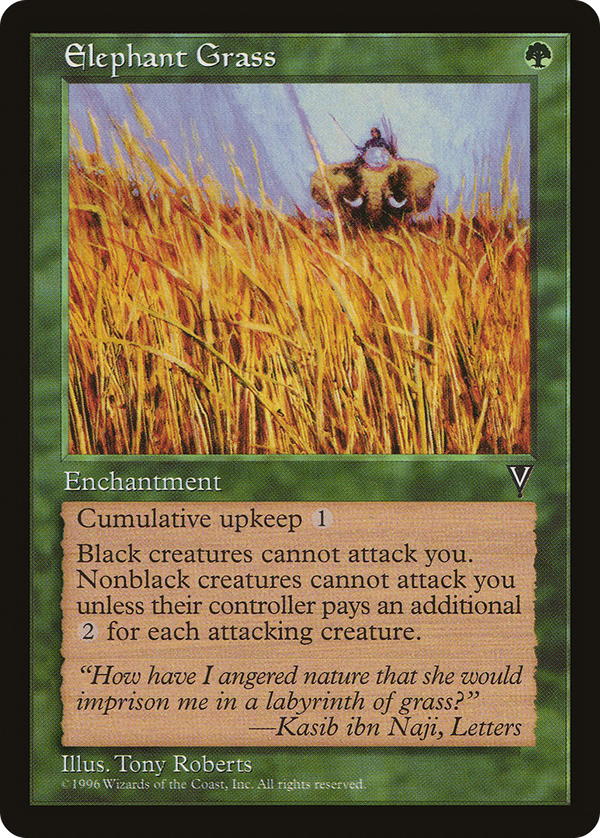
Black creatures are locked out of attacking you entirely, no questions asked; everyone else has to commit two mana per attacker just to declare combat against you, which makes alpha strikes financially absurd in the early game. That tax compounds against go-wide aggression precisely when the aggressor can least afford it, buying the defending player the first several turns of the game more or less for free. The design here is a study in deliberate impermanence: cumulative upkeep is the meter running, and the age counters that steadily drain the controller's tempo make the enchantment self-limiting. By the time you have paid the upkeep four or five times, the enchantment costs more than it stops, and you let it die. So this is a card built to do one job (stall the opening) and then politely retire, rather than a permanent fixture. The age-counter clock is the balancing discipline; without it, a green enchantment that broadly forbids combat damage at the cost of a single mana would be oppressive in any deck that simply wanted to durdle toward a payoff. With it, Elephant Grass is a finite, front-loaded purchase: enormous value in the first few upkeeps, a liability by the late game, and a clean expression of how cumulative upkeep was meant to price a powerful effect by the turn rather than by the spell.
Rules text
 (At the beginning of your upkeep, put an age counter on this permanent, then sacrifice it unless you pay its upkeep cost for each age counter on it.)
Black creatures can't attack you.
Nonblack creatures can't attack you unless their controller pays
(At the beginning of your upkeep, put an age counter on this permanent, then sacrifice it unless you pay its upkeep cost for each age counter on it.)
Black creatures can't attack you.
Nonblack creatures can't attack you unless their controller pays  for each creature they control that's attacking you.