Eldrazi Ravager


The old bargain with big Eldrazi was that you paid for the beating and then, if the game went long enough, you paid again by drawing them in the wrong moment. This one closes both leaks. The cycling clause turns a dead six-drop in the opening hand into a card off the top, so the floor stops being a brick. The graveyard recursion turns the ceiling into an engine: sacrifice two Eldrazi, get this back, and a deck built to churn colorless bodies never runs out of the thing it wants to be casting. Annihilator 1 keeps it in the family of colorless menaces that tax the defender's board just for surviving an attack, but the number is deliberately modest; the payoff here is not one crushing swing, it is the repeatability. What makes the recursion honest is the cost being other Eldrazi rather than any two permanents, which asks the deck to commit to the tribe rather than pay in whatever happens to be lying around. That trio of modes, an early cantrip, a late threat, and a self-returning attacker, is a lot of flexibility loaded onto a single colorless creature, and it reads as a modern refinement of the whole Eldrazi design conversation: give the payoffs a way to matter at every stage of the game, not just the turn the mana finally arrives.
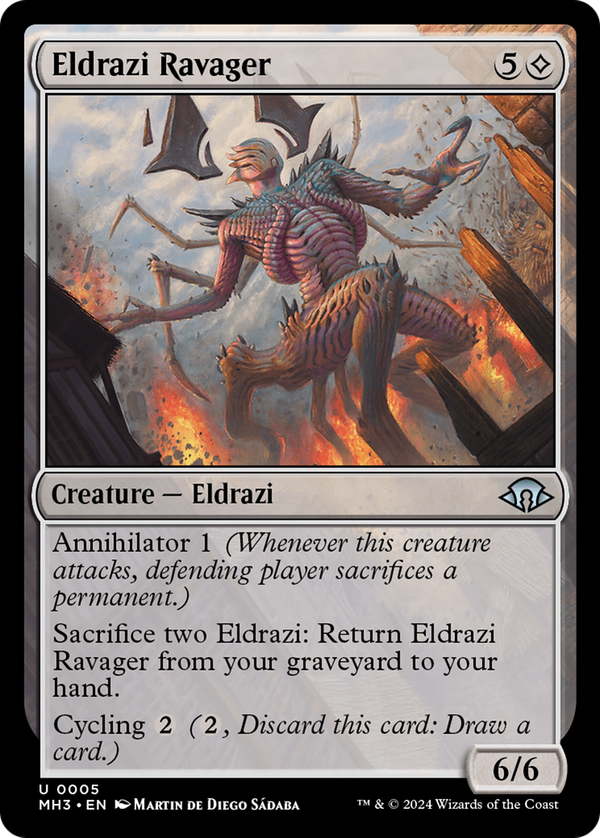
Rules text
 (, Discard this card: Draw a card.)