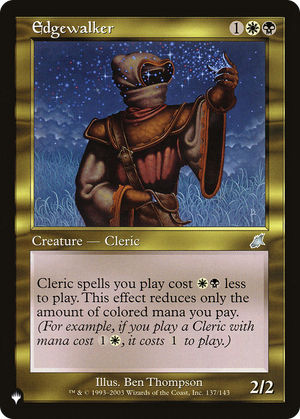
Edgewalker



Cost reduction printed onto a tribe is a load-bearing design decision, and few early creatures were built so completely around it. The reduction here only touches colored mana, the restriction that keeps the engine from spiraling: a Cleric whose cost is mostly generic gets little discount, while one priced deep in white and black drops toward free. That asymmetry shapes what the card wants alongside it. It rewards small, color-intensive Clerics cast in chains rather than a single expensive payoff, because each spell sheds at most two pips. The deeper consequence is that it pushes a tribal deck past linear curve-out and into combo territory: stack enough cheap Clerics that gain or drain life, and the reduction turns a normal turn into a flood of triggers. The 2/2 body is incidental; nobody plays this to attack. It exists to make the rest of the hand cheaper, which is fragile (a removal spell aimed at the enabler resets the whole plan) but potent when it survives. The lineage is creatures that subsidize their own kind, the white-black answer to tribal acceleration that other colors handle with mana dorks or affinity. Where those produce mana, this one simply waives the price, and the difference matters: the discount applies to every Cleric spell you cast in a turn, but the colored-only clause means it can never be the whole engine by itself.
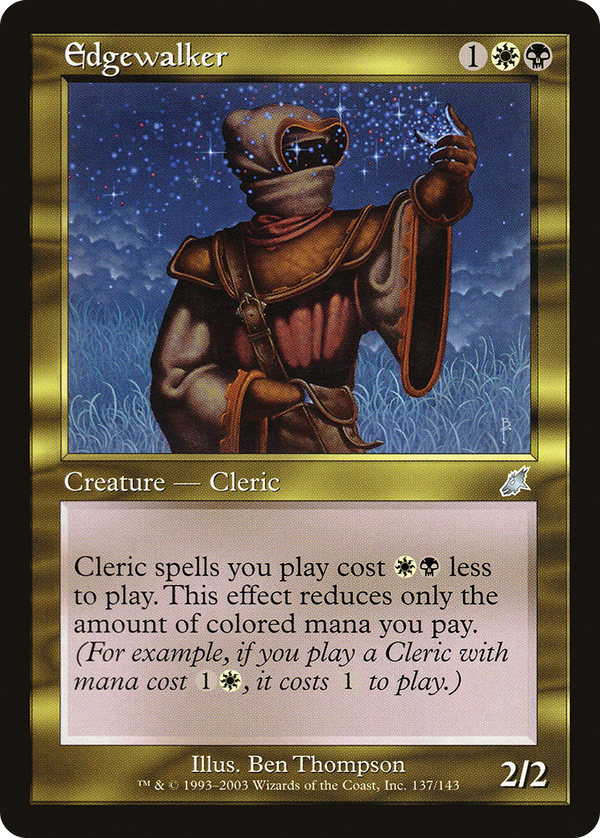
Rules text
less to cast. This effect reduces only the amount of colored mana you pay. (For example, if you cast a Cleric spell with mana cost , it costs to cast.)