Earthquake Dragon


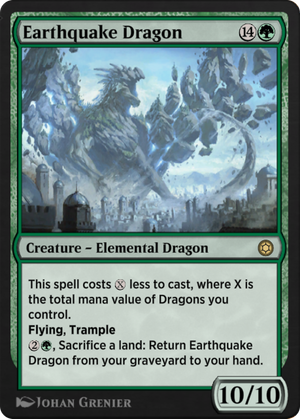
The printed cost is a bluff. Fifteen mana buys a 10/10 flyer with trample, which on paper is absurd, but the cost reduction rewrites the equation: every Dragon already on the battlefield shaves its own mana value off the total, so the thing that looks unplayable becomes a natural extension of what a tribal deck was already doing. Four or five Dragons out and it lands for a fraction of the sticker price, sometimes for a single green. The design is a payoff dressed as a beater: it does nothing to lower the cost of the first Dragon, but each Dragon already in play cuts down its own cost, so its real function is to reward a board already assembled. The land-sacrifice recursion is what saves it from being a single desperate gamble. Returning it from the graveyard for a modest cost plus a land means a wrath does not permanently answer it; you fold the land loss into the tribe's usual ramp and swing again next turn. It is a top-end finisher whose entire economy is contingent on the shell that surrounds it, a card that reads as impossible in isolation and inevitable once the Dragons pile up.
Rules text
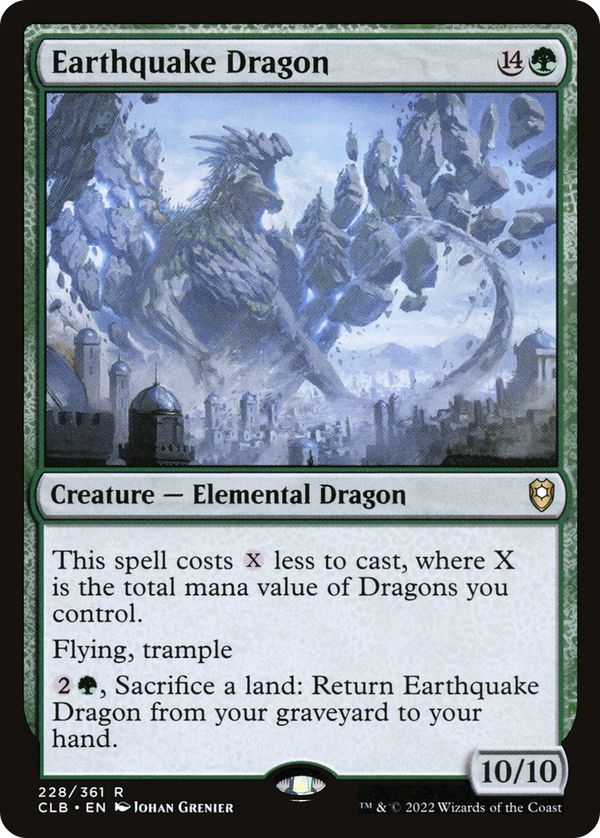
 less to cast, where X is the total mana value of Dragons you control.
Flying, trample
less to cast, where X is the total mana value of Dragons you control.
Flying, trample
 , Sacrifice a land: Return this card from your graveyard to your hand.