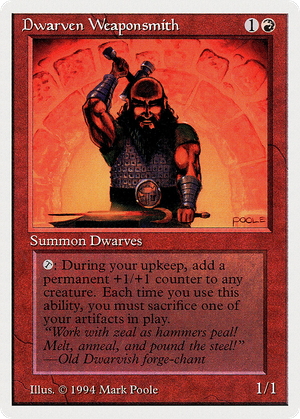
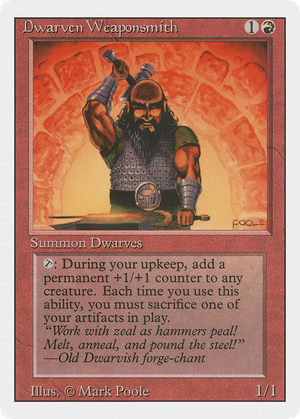
Dwarven Weaponsmith


The upkeep restriction is the entire design. Strip it away and you have a repeatable artifact-to-counter pump that would have warped every format it touched; bolt it to upkeep and the card becomes a slow, ceremonial engine that grants exactly one counter per turn cycle, fully telegraphed, with no combat-trick potential and no way to chain activations in response to removal. The tap symbol already prevents reuse within a turn, but the upkeep clause goes further, sealing the window so tightly that the conversion can only happen on your own time, before you have even drawn for the turn. That double-gating is a relic of early design discipline: later templating mostly trusts the tap symbol and summoning sickness alone to keep iterative effects honest, where this card belts and suspenders the same loop shut. It also sits inside its set's central thesis, where artifacts are resources to be spent rather than permanents to be protected, and a Dwarf body is happy to be the conversion mechanism. The rate is archaic: a 1/1 for two that needs an artifact, a turn, and a tap to do anything, in service of growing a creature you also have to protect. What survives is the structural idea, the sacrifice-for-counters loop that later cards executed at instant speed, on enters-the-battlefield triggers, or without the artifact cost at all. This is that engine drawn at its slowest legible speed, with every safety the rules text could bolt on still attached.
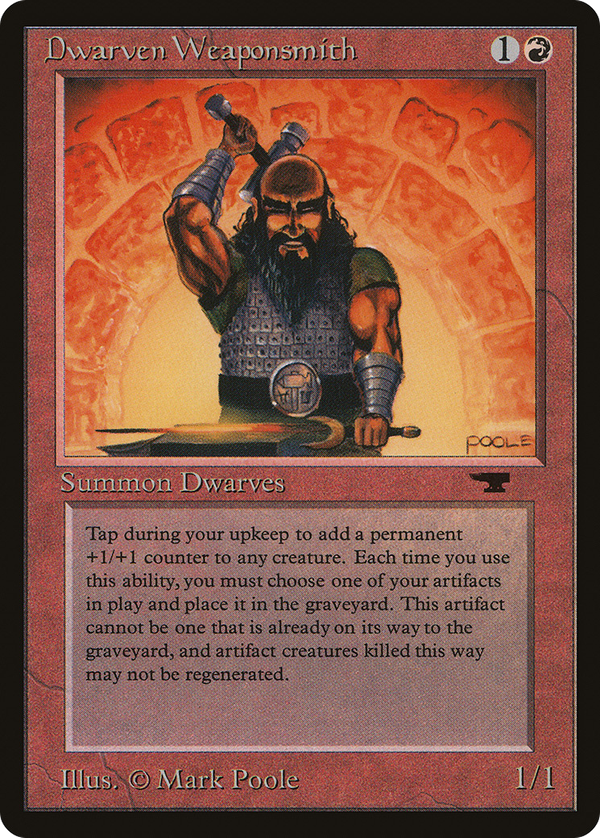
Rules text
 , Sacrifice an artifact: Put a +1/+1 counter on target creature. Activate only during your upkeep.