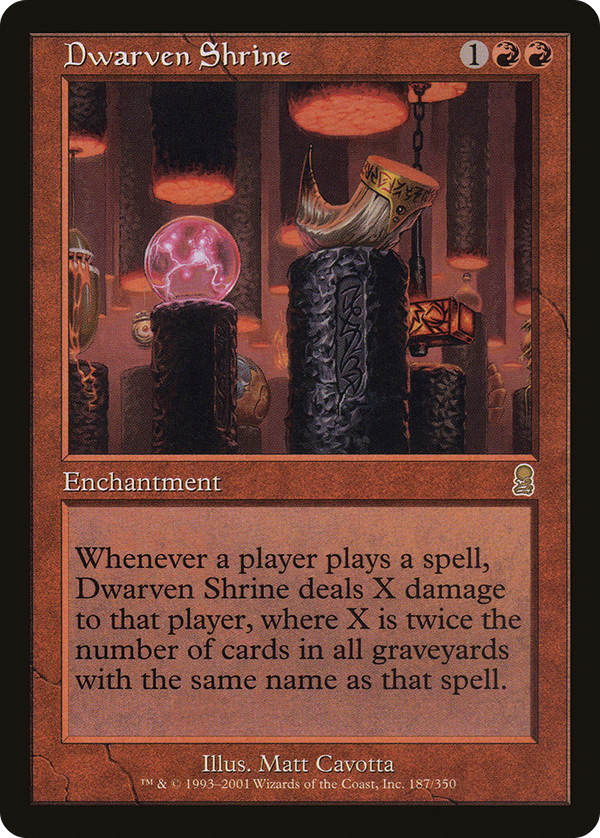
Dwarven Shrine


This is the punitive flip side of the era's graveyard-as-resource thesis: a symmetric tax that scales not with how much a player casts but with how much redundancy already sits in every graveyard. The damage keys off cards sharing the spell's name, so it does nothing in a singleton-heavy game and bites hardest against the four-of. Cast your third Lightning Bolt and the two copies already in graveyards deal you four damage; the fourth copy faces three already waiting, for six. That naming clause is deliberate friction. It rewards diverse spell selection and savages the consistency competitive decks are built on, but it fires on everyone equally, so the controller pays the same toll on their own repeated spells. The effect punishes the format's structural habits rather than any one strategy: aggressive decks lean on cheap repeated burn, control decks lean on repeated counters and draw, and this taxes the repetition itself. Because every graveyard counts and cards accumulate there across the whole game, the threat compounds the longer the table grinds, which sits in productive tension with the symmetry. You want it down early so the graveyards have time to fill, but every spell you cast afterward stocks the same gun pointed back at you.