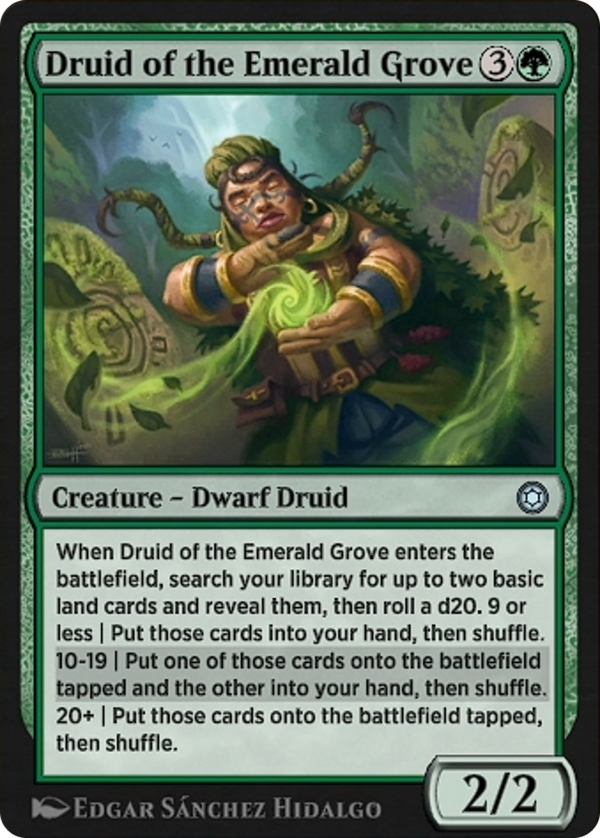
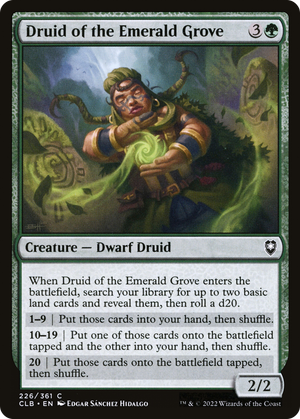
Druid of the Emerald Grove


Ramp with a variance dial. The floor is a two-basic tutor stapled to a body, a dead-even trade you'd expect from a four-mana dork: you pay full price to fetch lands to hand and get a 2/2 for the trouble. The d20 is what pays for that flat rate. The middle band, the widest span on the die, ramps you one land and cushions the miss with a card in hand; the natural 20 turns the same enter trigger into a two-land explosion that pushes you well ahead of curve. What makes the design coherent rather than just swingy is that every outcome puts basics somewhere useful: even the low roll refills your hand, so no result whiffs entirely. That distinction separates a die-roll payoff built to feel bad occasionally from one built to feel worse only relatively. It sits in the family of enter-the-battlefield ramp bodies that trade a mana dork's speed for a guaranteed land count, closer in spirit to a creature-shaped Cultivate than to Llanowar Elves: you're not accelerating a turn ahead so much as thickening your board and fixing your colors in a single stroke. The dwarf-druid line and the twenty-sided die both tie it to a specific flavor of tabletop crossover, where the roll does double duty as mechanic and homage.