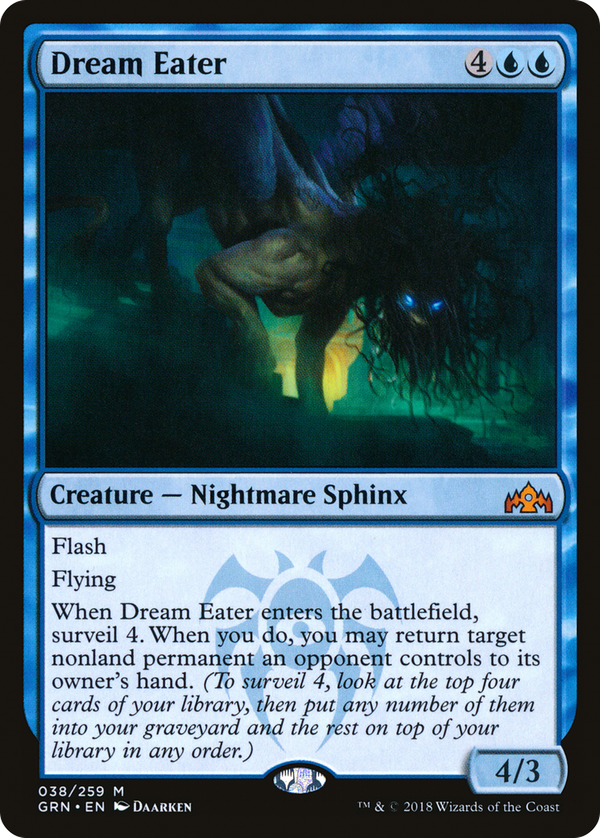
Dream Eater


Flash is what turns this from a fair tempo creature into a trap. The instinct is to read the body as the bottleneck (a 4/3 flyer for six mana is a respectable but unremarkable rate), but the card was never meant to be deployed on your own turn. Held up at the end of an opponent's turn, it presents a 4/3 ambush blocker, a four-card dig that fixes your next several draws, and an unconditional bounce of any nonland permanent they control, all stapled together at the moment of maximum information. The surveil-into-bounce structure is sequenced deliberately: you see the top four and decide what to keep before you choose the target, so the dig informs the tempo play rather than the other way around. The bounce is gated behind the surveil resolving ("when you do"), which keeps the two effects linked rather than letting you split them; in practice the trigger always resolves, so the clause reads as flavor more than restriction. What it represents is the late-2010s blue control creature done right: not a Snapcaster-style spell engine, but a single card that buys a turn, refills, and answers a board threat in one flash. The bounce is soft removal, not an answer to anything that stays gone, and it can only ever target something an opponent controls, so it never buys back its own value. That is what you pay for hanging this much dig and tempo on a flying body: the card trades on timing and information, not on durable board advantage.