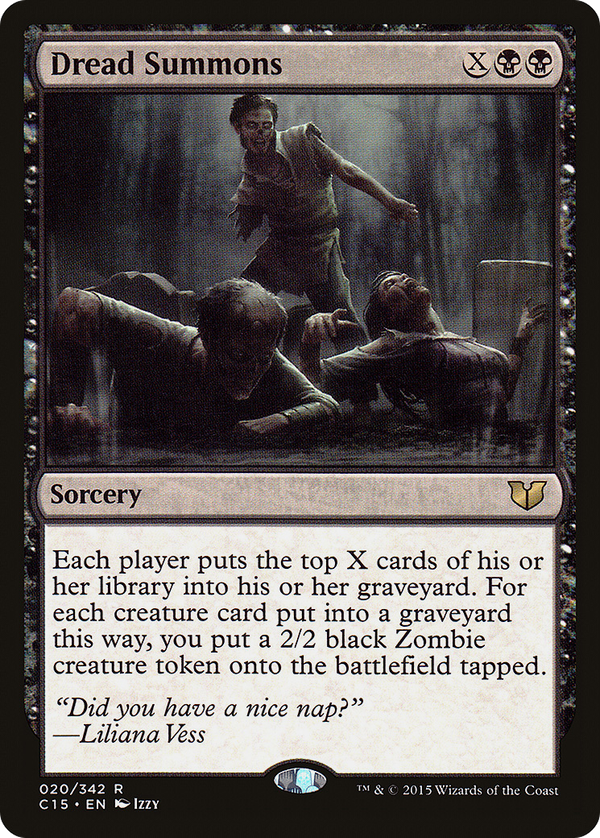
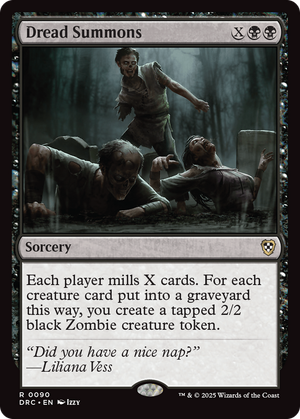
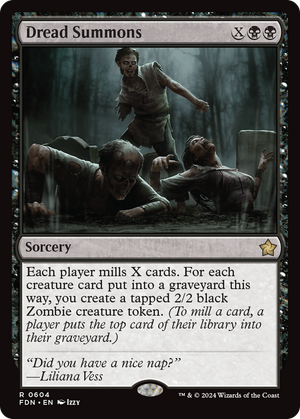
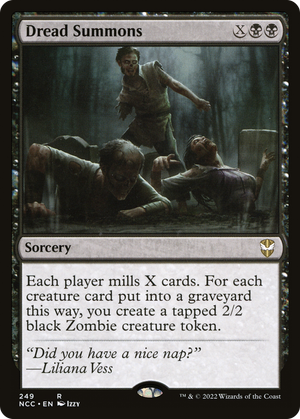
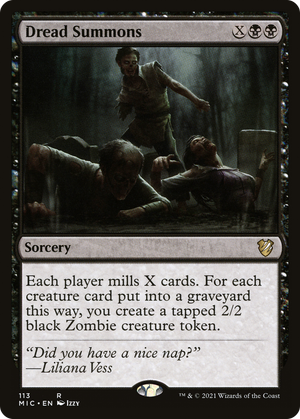
Dread Summons
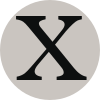

Most symmetrical mill asks the caster to gamble on decking an opponent out before the shared cost of feeding every graveyard turns around and bites. This inverts that arithmetic. Every creature card that lands in a yard, yours or anyone else's, becomes a tapped 2/2 Zombie under your control, so the wider the X and the more creature-dense the libraries in play, the more that symmetric mill launders into a private army. The tokens arriving tapped is the restraint that pays for the breadth: a fresh board of Zombies can neither block nor swing the turn it appears, which stops a big X-spell from moonlighting as a defensive board-wipe answer or an immediate alpha strike. Being a sorcery already binds the cast to your own main phase; the tapped clause keeps the bodies themselves out of the following combat too. The self-mill component does double duty, stocking a reanimation or graveyard-matters shell while the tokens supply the on-table value that pure mill usually lacks. That is the real trick: the card cares nothing for whether anyone approaches an empty library, only for how much creature material it can convert. The tradeoff is variance. You pay for an outcome you cannot fully preview, since the creature count inside the milled chunk decides whether you assembled a board or shoveled a fistful of lands and instants into everyone's yard for nothing.