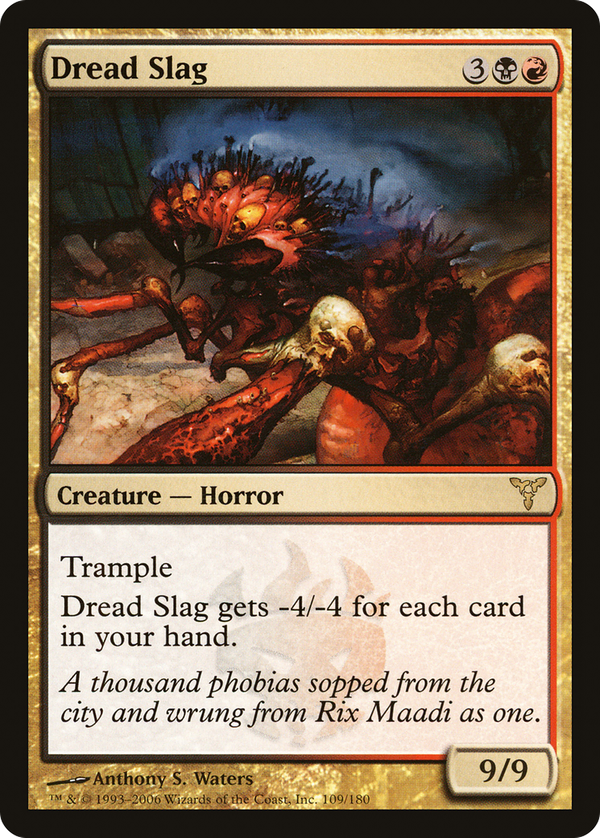
Dread Slag



Hellbent rendered as a literal subtraction problem. A 9/9 trampler for five sounds undercosted until you read the penalty: every card in your hand strips four power and four toughness, so the printed body is a fiction the moment you draw. Hold one card and it arrives as a 5/5; hold three and it lands as a dead 9/9 dragged well past zero, dying before it can attack. The empty-hand requirement is the whole balancing mechanism, and it points the card toward decks built to dump their resources before turn five rather than hoard them. The cruelty is structural: the very state that maximizes its size (no cards) is the state where you most want to be refueling, so casting it commits you to staying empty when instinct says draw. Trample is what makes the gamble pay; at full nine power, blockers chip at it rather than stop it, and the damage spills through. It belongs to an older school of design that sold raw stats against a self-imposed discipline, trusting an aggressive black-red deck to engineer the empty hand rather than back into it. Outside that discipline it is a hazard you cast at your own risk; inside it, a closer whose size grows precisely as your safety net vanishes.