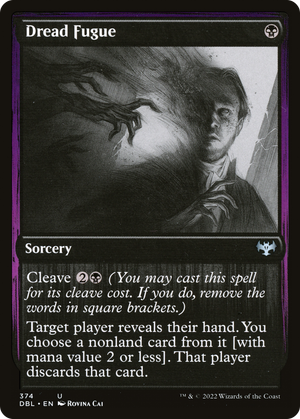
Dread Fugue

Cleave lets one card occupy two points on the curve without printing two cards, and this is among its cleanest arguments. For a single black mana, it is targeted hand-reading discard with a ceiling: you see the whole hand but can only pull a nonland card worth two or less, which reads as an early tempo strike that clips a one- or two-drop problem before it lands. Pay the cleave cost of  instead and the bracketed restriction vanishes, promoting the same spell into an unconditional Coercion that lets the caster pull any nonland card from the revealed hand. The elegance is that the constraint is priced rather than fixed: the one-mana mode stays honest against combo and aggro hands, while the three-mana mode becomes a mid-game answer to the bomb an opponent has been sandbagging. That is the appeal of discard that scales, since most such spells commit to a single shape and go dead once the game moves past it. The choice of mode is locked in as the spell is cast, before the hand is revealed, so cleave is really a bet about which threat range matters: the cheap window early, the open window late. Reveal-and-choose then does the second half of the work, letting the caster surgically remove the worst card in the revealed hand rather than surrendering the pick to a random discard.
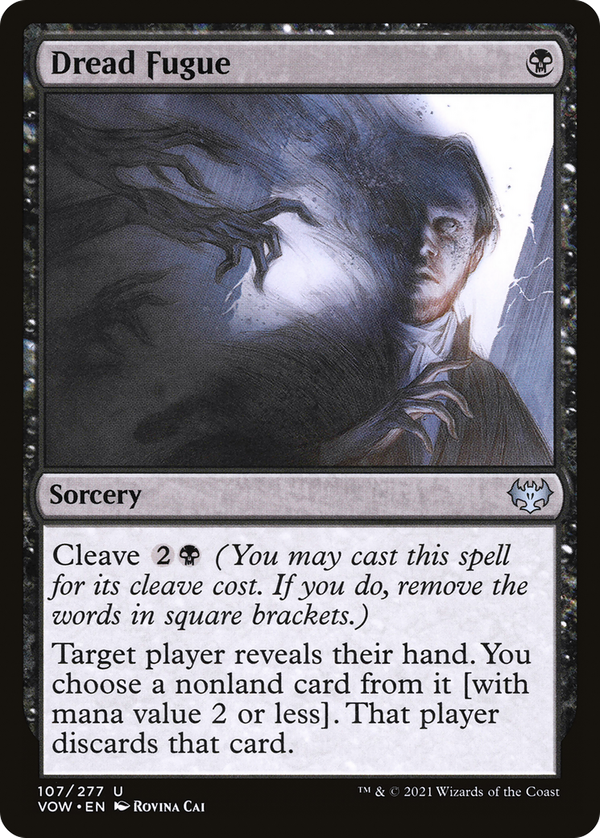
Rules text
(You may cast this spell for its cleave cost. If you do, remove the words in square brackets.)
Target player reveals their hand. You choose a nonland card from it [with mana value 2 or less]. That player discards that card.