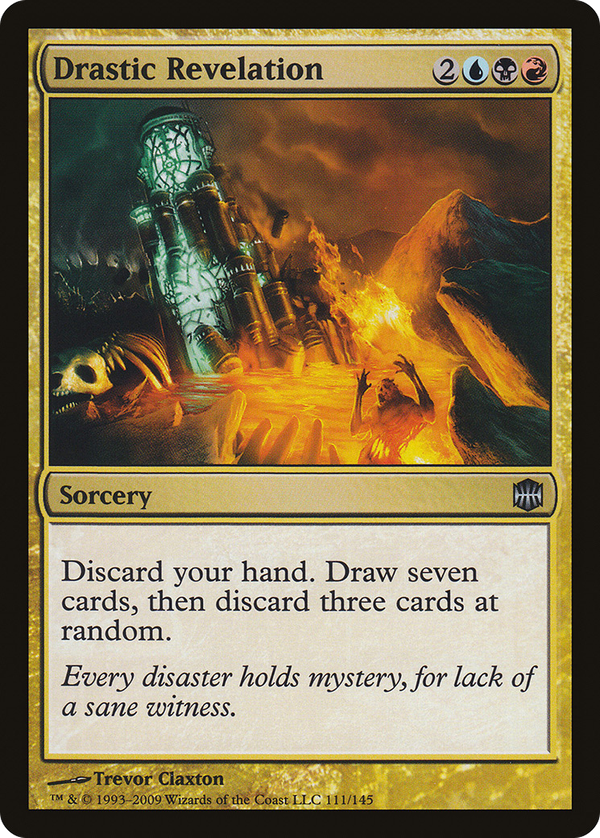
Drastic Revelation




The wheel effect with a cost attached, and the cost is steep enough to be the whole design conversation. Trading your hand for seven new cards is the dream Wizards has always priced carefully: Wheel of Fortune does it for three mana and got restricted out of nearly everything, Timetwister joined the Power Nine, and every printing since has tried to find a tax that makes the effect fair. Here the tax is unusually punishing for what should be a refill. You discard your existing hand before drawing, so the seven cards refill an empty grip rather than adding to what you held, and then three of those seven get discarded at random, netting you four cards you never chose. That random discard is the lever the design pulls: it turns a clean card-advantage spell into a graveyard-feeding lottery, which is the entire point. The card was built for a strategy that wants cards in the bin as much as in hand, where dumping a full grip and pitching three at random is upside, not loss. As a pure draw spell it is among the worst rates ever printed for the effect; as a discard outlet that happens to refill, the math reads completely differently. The three-color cost narrows it to decks already committed to graveyard recursion or reanimation payoffs, which is exactly the audience that reads "discard three at random" as a feature rather than a tax.