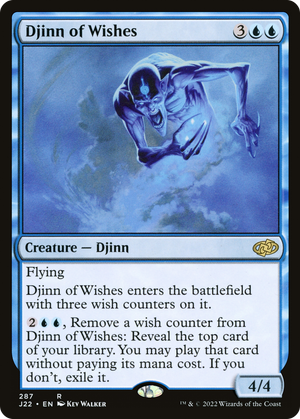
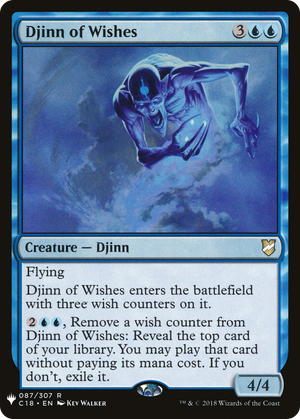
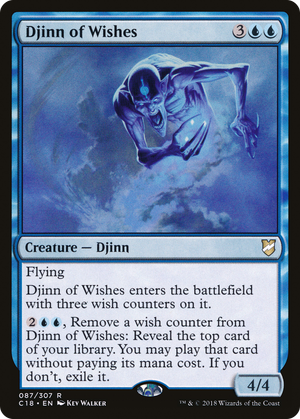
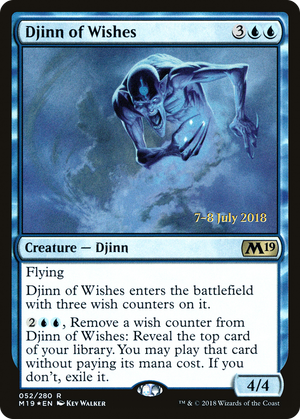
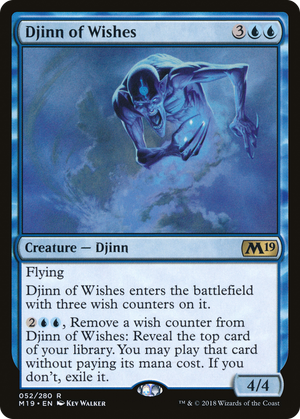
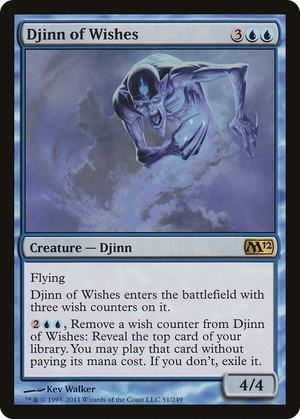
Djinn of Wishes


Reveal the top card of your library and play it free, three times: a fantasy blue decks have chased ever since they learned to manipulate the top of their library. The catch is the exile-on-refusal clause, and it is the whole balancing act. Each of the three wish counters is a one-shot gamble that costs you the card whether you keep it or not, so the activation is never a free dig; it is a commitment to play whatever sits on top. The reward scales with how much you can stack the deck in your favor, which is why this body has always belonged to top-of-library manipulation shells rather than fair midrange. A 4/4 flier for five is a serviceable clock, but the counters are the reason to run it: they reward sequencing your library so the reveal is a known quantity, scry and surveil and tutors-to-top turning a coin flip into a guaranteed free spell. Park a high-cost payoff on top (an Eldrazi, a bomb you could never hard-cast on curve), and the activation cost stops looking like a deal and starts looking like a heist, because you are spending a counter and four mana to cheat something far larger into play. Left to chance, it is a feel-bad lottery. Built around, it is a repeatable cheat-into-play engine wearing the body of an evasive beater.
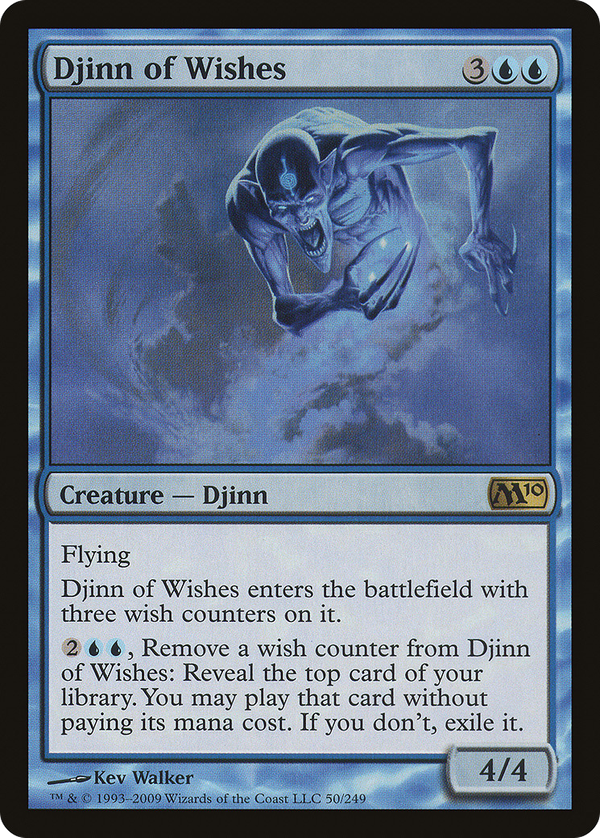
Rules text
 , Remove a wish counter from this creature: Reveal the top card of your library. You may play that card without paying its mana cost. If you don't, exile it.