Divine Congregation


Lifegain that scales off an opponent's board is a strange thing to want, and stranger still to suspend. The effect reads as a defensive panic button: when an aggressive deck has flooded the battlefield, this rewards you for exactly how dire your position has become, gaining more life the deeper underwater you are. But the suspend cost rewires when that panic button gets pressed. Paying the suspend cost early commits to the spell five upkeeps in advance, so the life arrives on a fixed timer rather than at the moment of crisis, and you cannot aim it at the opponent whose board is largest until the counters have already counted down. That tension, a reactive effect locked behind a proactive cost, leaves the card more curiosity than tool. Suspend was an early-era experiment in selling cards at a discount in exchange for surrendering control of timing, and most of the cycle paired that discount with effects worth waiting for: a creature, a sweeper, a draw spell. Bolting it onto raw lifegain that targets any player, including one whose creatures you have no quarrel with, exposes the seam in the mechanic. The discount is real, but the thing you are buying does not improve by arriving late, and the lifegain does not threaten anything. It is a clean illustration of suspend's limit: the mechanic flatters effects that scale or stabilize, and does nothing for an effect that only ever buys a few turns.
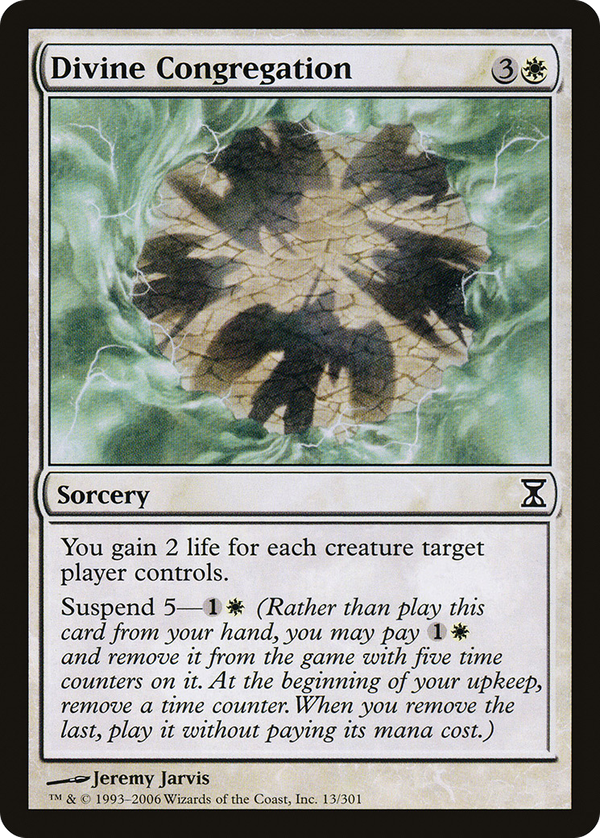
Rules text
 (Rather than cast this card from your hand, you may pay and exile it with five time counters on it. At the beginning of your upkeep, remove a time counter. When the last is removed, you may cast it without paying its mana cost.)