Disrupt

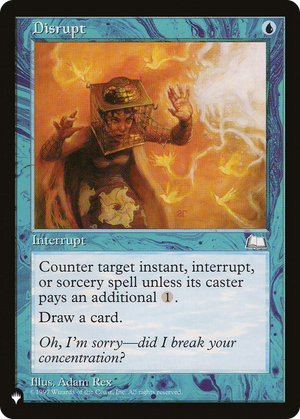
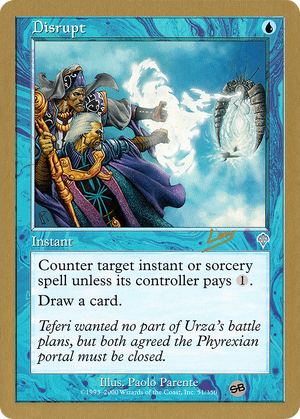
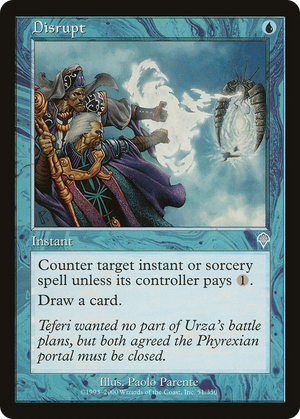
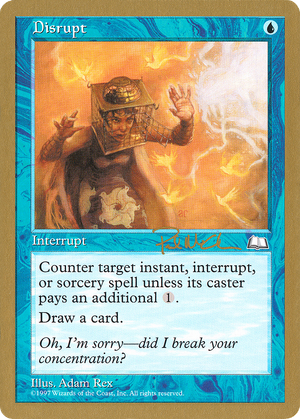
The cleanest expression of the conditional counterspell, and the one whose math is most honest about what it asks. For a single blue mana, it demands only one more to break, which rarely stops a spell the opponent actually wants to resolve: pay the tax and move on. What it really buys is the cantrip. Disrupt counters nothing most of the time and still replaces itself, which reframes the card as a cantrip with a tax stapled on rather than a counter with a draw attached. The targeting is narrow on purpose: instants and sorceries only, no creatures, no permanents. That restriction is what lets the effect cost so little and replace itself without becoming a hard counter for the cheapest spells in the game. There is a tether on the cantrip, though: the spell needs a legal instant or sorcery on the stack to target, so it cannot simply be cracked for a card into an empty board. It pays out only when there is a spell on the stack to aim at. This is the soft-counter-as-tempo-tool template that later designs refined along different axes: Daze hands you a free counter at the cost of a land, Spell Pierce taxes the noncreature spell, Miscalculation scales the price to two. Each picks a different lever on the shared premise that a counter you can pay around is acceptable when the floor is a card that replaces itself.
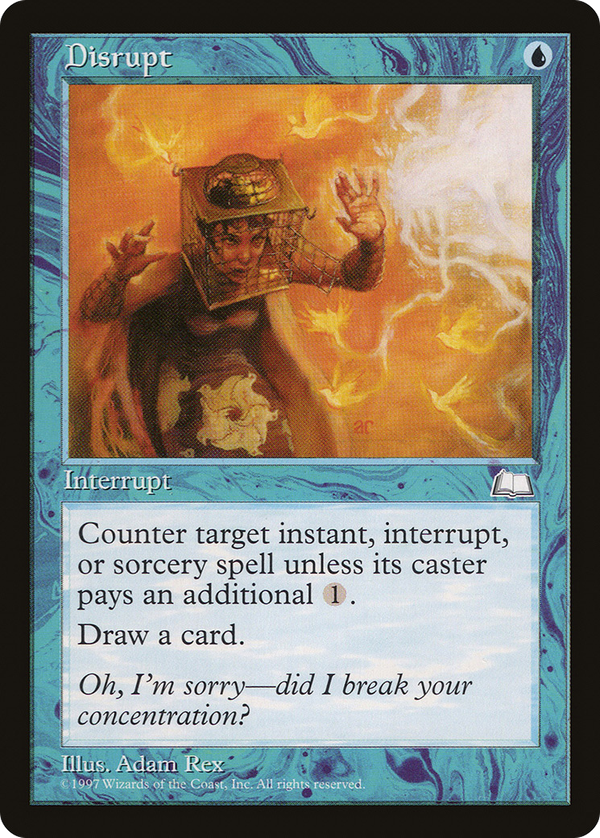
Rules text
 .
Draw a card.
.
Draw a card.