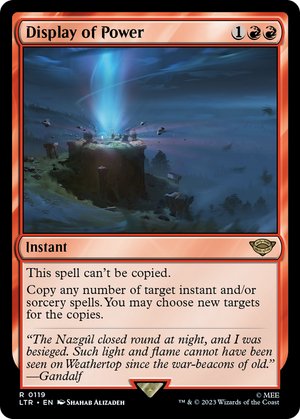
Display of Power


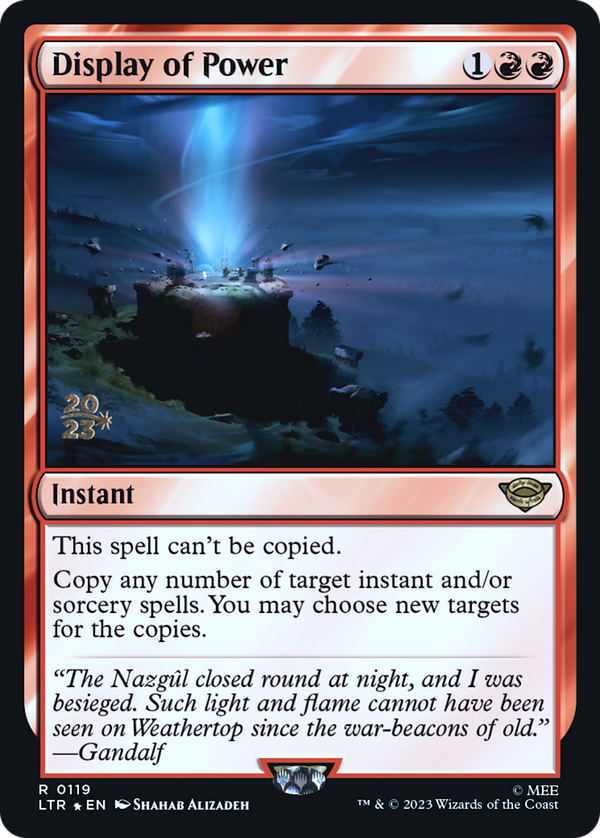
Fork's whole lineage has been about copying one thing: Fork itself hit an instant or sorcery, Reverberate did the same, Twincast broadened the target set to any spell. This tightens the target back to instants and sorceries but does something none of them do: it copies any number of them at once. That reframes the card from a reactive one-for-one into a fork that scales with the stack. In a storm-adjacent or spell-chaining turn, a table full of pending burn, draw, and tutor spells all resolve twice; the more the stack holds, the more the card returns. The line "This spell can't be copied" is the tell that the designers understood the loop they were opening: without it, a second copy effect pointed at this one would recur the whole batch into an unbounded engine, so the card walls off its own recursion while leaving every other copyable spell fair game. The freedom to choose new targets keeps the copies from being dead: point the duplicated removal at a fresh threat, redirect a duplicated bounce, or aim a copied burn spell at a different face. It reads like a single-target trick and behaves like a mass-copy payoff, which is the design tension that separates it from the one-target copiers it descends from.