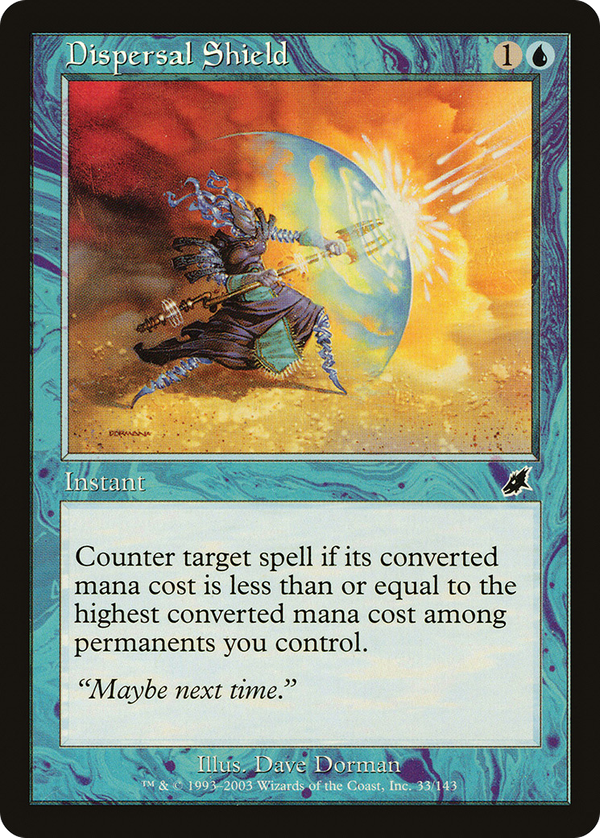
Dispersal Shield


Counterspells usually scale with what your opponent is doing; this one scales with what you've already built. The condition reads backwards from the norm: instead of asking how much mana your opponent has access to, it asks how big the biggest thing you control is, then refuses anything cast for that value or less. With nothing in play it can still stop a zero-cost spell (the greatest mana value among no permanents is itself zero), but its window only opens as your board grows, and a single fattie on the table is enough to bounce most reasonable threats off the stack. That inversion is the whole design problem it resolves, and it makes the card a poor fit for the dedicated permission deck (the archetype that least wants permanents tying up the battlefield) and a natural fit for ramp and big-mana shells that were already going to land a high-mana-value creature anyway. The result is a counter that gets stronger the longer the game runs and the further ahead you already are, which is the opposite incentive from the usual hold-up-mana, react-on-their-turn permission plan. It belongs to an era of conditional answers that ask you to earn your interaction through board state rather than mana efficiency, a design lineage Wizards has returned to whenever it wants permission to cost something other than blue mana and a held-up turn.