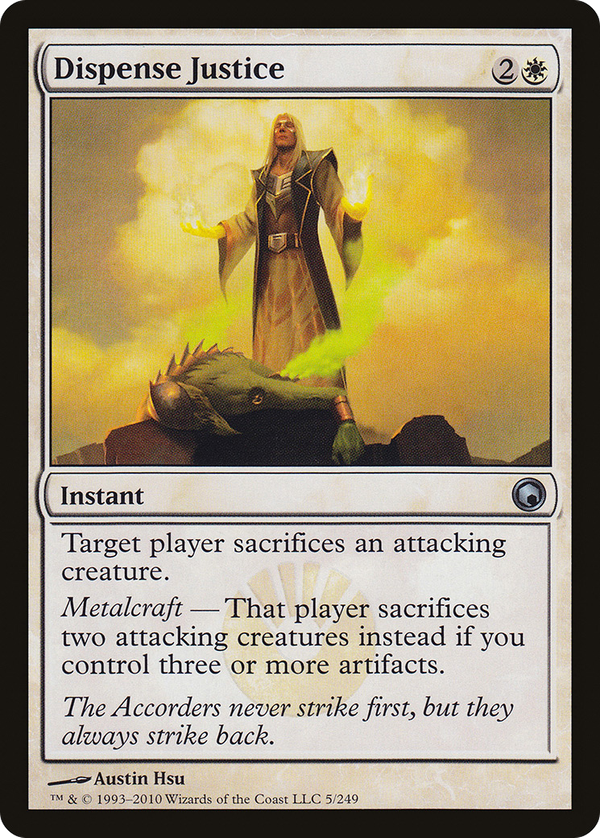
Dispense Justice


Edict effects route around the defenses targeted removal cannot touch: by forcing the controller to choose what dies, they slip past hexproof, protection, and the indestructibility that turns Doom Blade into a blank. The constraint here is that the spell only catches attacking creatures, which narrows it from a general answer into a combat tool. That narrowing is the trade: you cannot point it at a parked threat or a freshly resolved bomb, only at something committed to the red zone. But once attackers are declared, at instant speed, it turns a swing into a tax, and the metalcraft clause doubles the bill. With three artifacts in play the attacking player gives up two of their attackers instead of one, the difference between blunting an alpha strike and breaking it. That conditionality is the design logic: a strict one-for-one combat edict is rarely worth a card, so the artifact threshold supplies the payoff that justifies the slot in a deck already built to clear it. It descends from the sacrifice-removal running through Diabolic Edict and Geth's Verdict, but where those let the caster pick the moment freely, this one binds itself to combat math in exchange for the chance to two-for-one. The catch the whole family shares: an opponent holding expendable fodder chooses what to lose, so the edict bites hardest when their board is exactly the threats they cannot spare.